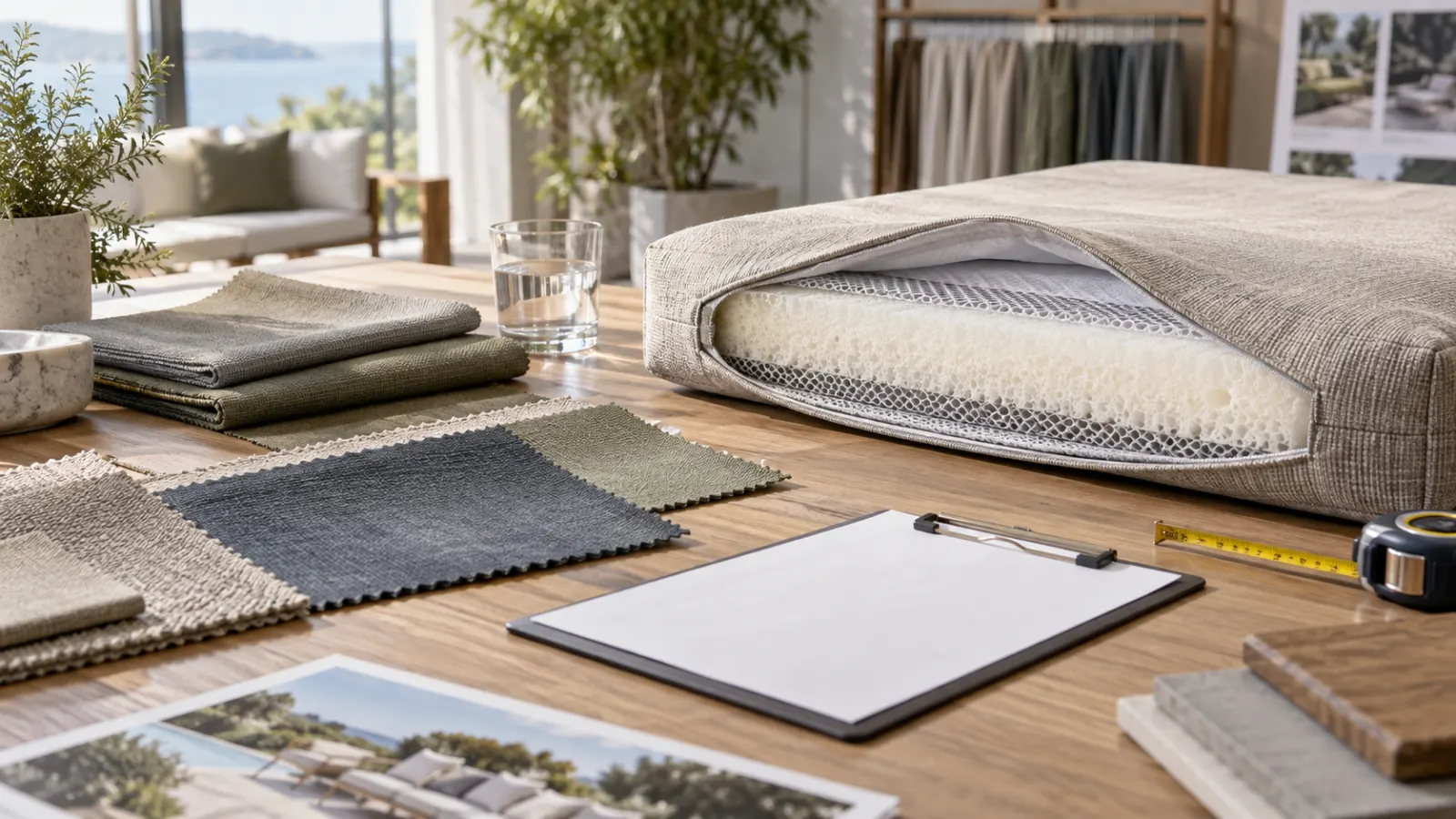
Short answer: For hotel and resort seating, specify each cushion by its exact installation zone, sun and rain exposure, fabric identity and comparable test reports, foam or fill, drainage path, seams and closures, attachment, cleaning method and replacement references. Approve a complete cushion on the intended frame; a loose swatch or generic “outdoor fabric” claim is not a complete specification.
Pool loungers, uncovered rooftop sofas and covered restaurant chairs do not face the same conditions. Buyers sourcing from China should send an exposure map and operating brief with their RFQ. This guide narrows the wider coastal material selection discussion to the cushion assembly and its handover records.
Map exposure and operations by zone
| Buyer input | What to define | Why it matters |
|---|---|---|
| Location | Covered terrace, open deck, poolside or coastal setting; shade and storage availability | Changes UV, moisture, salt-spray and drying demands |
| Use | Guest turnover, frequency of cleaning, spills and movement between zones | Changes cover construction, cleanability and replacement planning |
| Operation | Who removes cushions during storms, how they dry and where they are stored | Water-resistant materials still need a realistic care process |
| Local requirements | Destination, project/fire-safety specification and who will review compliance | Testing and acceptance depend on jurisdiction and installation |
Do not infer a fire rating, waterproofness or expected lifespan from the fiber name. Ask the project specifier and destination authority to confirm applicable requirements before locking the material.
Request fabric identity and comparable evidence
Record the mill or supplier, exact fabric code, fiber content, dyeing/construction, finish, color lot and care instructions. Ask for the actual candidate fabric's dated report, sample identification and test method for relevant properties such as lightfastness, wet/dry color transfer, abrasion and physical strength. Ask whether the proposed finish changes the recommended cleaning agents.
The Association for Contract Textiles (ACT) voluntary performance guidelines distinguish woven, coated and knit constructions and indoor versus outdoor uses. ACT also notes that laboratory results do not fully predict field performance. Use those sources as a way to ask better comparative questions, not as proof that any SOLAIREVA fabric carries an ACT mark or meets a particular rating. Reviewed 16 September 2026.
- □ Is the report for the proposed fabric code and color, not a different collection?
- □ Are two quotes reporting the same method and conditions before comparing numbers?
- □ Is the fabric intended for the actual exposed or covered location?
- □ Has the hotel approved color under its real daylight and adjacent finishes?
Specify the complete cushion build
A water-repellent cover can still admit moisture through seams, zippers or prolonged exposure. Define the outer cover, seam and closure construction, inner liner if any, foam or fill, and how water leaves and air reaches the assembly. Ask for the supplier's drying and storage instructions for the exact build. “Quick dry” should be explained as a system and supported by a representative sample, not assumed from a fabric label.
| Assembly | Approval question |
|---|---|
| Cover | Can staff remove it without damaging seams, and are closure/attachments accessible? |
| Fill | What is the specified foam or fiber build, firmness and dimensional tolerance? |
| Drainage | Where can retained water leave; what drying procedure is realistic on site? |
| Fit | Does the cushion stay in place on the approved frame without blocking normal use? |
Check comfort, thickness, fit and finished dimensions on the actual frame during sample approval. Preserve the signed cover and fill references before bulk production.
Agree on cleaning and replacement before ordering
Give the supplier the hotel's normal cleaning agents and ask for written compatibility and stain-care guidance for the exact material. Avoid assuming bleach, pressure washing or machine washing is safe. Define what staff should do after prolonged rain, what can be removed for cleaning and how damaged covers or inserts are ordered. The spare-parts guide explains how to retain SKU, revision, swatch and replacement compatibility records.
Cushion specification questions to copy into an RFQ
- □ Which exact seating SKUs and project zones need cushions?
- □ What are the final cover fabric code, color lot, finish and maintenance instructions?
- □ Which dated, model-specific reports support the requested fabric performance?
- □ How are fill, seams, zippers, attachments and drainage constructed?
- □ What complete sample, dimensions and signed records will be approved?
- □ What is the replacement cover/insert ordering reference and packing method?
- □ Who verifies destination-specific project and fire requirements?
Use the broader commercial outdoor furniture RFQ checklist to keep supplier comparisons aligned. Review the official product collections and factory overview, then send your intended zones and specifications through the official contact page.
Frequently asked questions
Is water-repellent fabric enough for an exposed hotel cushion?
No. Check the whole cover, seams, fill, water path and operating procedure. Approve a complete sample for the intended installation, not a swatch alone.
Is there one abrasion number for every hospitality cushion?
No. State location, traffic, fabric construction and applicable method; compare like-for-like reports. Laboratory abrasion alone cannot guarantee service life.
How do we preserve replacement compatibility?
Keep the frame SKU/revision, shape and dimensions, cover pattern, fabric and color reference, fill and attachment method, and the approved sample record.
Next step: Share the zone map, selected seating models and cleaning requirements through SOLAIREVA's official enquiry channel → for a project-specific cushion discussion.