Outdoor furniture landed cost is the itemized estimate of what a hotel buyer pays to move specified furniture from a China supplier to the agreed receiving point. Build it from a comparable product quote, the agreed delivery term, transport and destination charges, plus only the taxes and services that apply in your market. Mark every line as included, estimated or still unconfirmed.
SOLAIREVA is a commercial outdoor furniture manufacturer based in Foshan, Guangdong, China, serving global B2B hotel, resort, restaurant and project buyers with OEM/ODM and a factory-direct export workflow. For your project, use the selected furniture models and written quotation as the starting point. This worksheet explains how to compare cost scopes; it does not publish universal prices, freight rates or duty estimates.
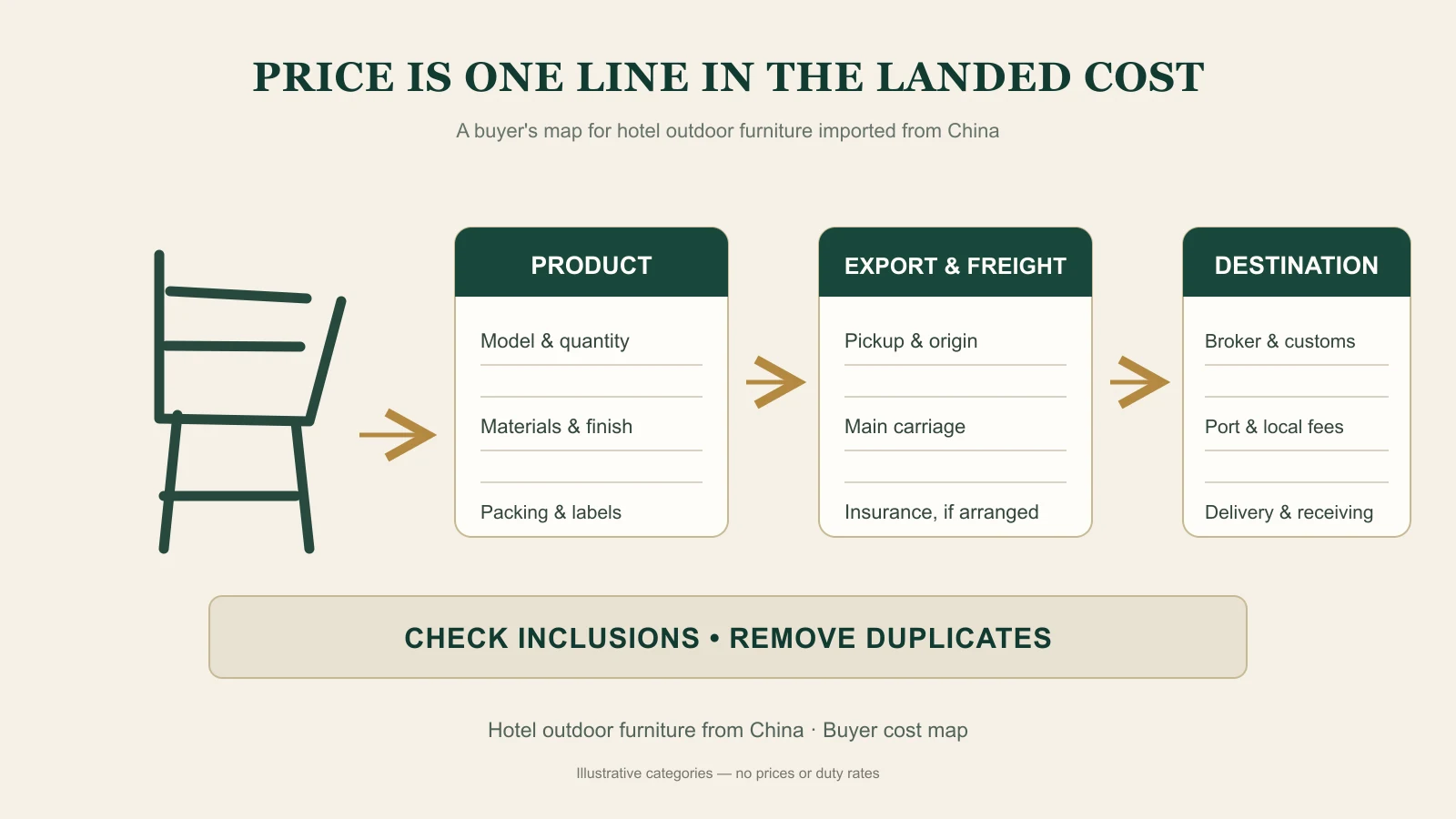
1. Define the outdoor furniture landed cost boundary
“Landed cost” is only comparable when both quotes end at the same point. One supplier may quote product collection at its premises; another may arrange main carriage; a third may estimate delivery to a project site. Write the receiving point at the top of your worksheet—for example, destination port, buyer warehouse or named hotel site—and state whether unloading and installation are included.
Keep product price and logistics scope visible as separate layers. The main-site China pricing guide explains why product quotations depend on model and specification. This article adds a buyer-side cost reconciliation for a hotel project, where transport and destination charges must be placed on the same comparison basis.
2. Freeze the quote inputs before comparing suppliers
A spreadsheet cannot repair mismatched offers. Compare the same product and commercial assumptions first. Record these fields for each supplier:
- Model or drawing revision, quantity by SKU, frame and surface specification, weave or upholstery choices, and approved finish.
- Packing method, units per carton, carton dimensions, gross weight, assembly state, and any buyer-required labeling.
- Currency, quote date, validity period, sample or tooling charges, and written payment terms.
- Named delivery rule, exact port/place/point and rule version, plus whether transport, insurance, export handling or destination delivery are quoted.
- Shipment mode and destination assumption supplied by the forwarder; identify whether a figure is a firm quote or a planning estimate.
The outdoor furniture RFQ guide helps buyers prepare a common input package. Here, use those confirmed inputs to audit the returned numbers and locate exclusions.
3. Build a China outdoor furniture import-cost map
Use rows rather than one “shipping” total. Ask who is responsible for each cost and where the supporting quote comes from.
| Cost layer | Potential line items | Evidence to record |
|---|---|---|
| Product and preparation | Furniture by SKU; agreed custom work; samples or tooling if applicable; export packing and marks | Supplier quotation, approved specification and written inclusions |
| Origin and export | Pickup, export handling, documentation or terminal services where separately charged | Named delivery term and forwarder/supplier scope; do not add a charge already included |
| Main transport | Ocean or other carriage; insurance if separately arranged | Route, service, validity, shipment basis and insurance scope |
| Import and destination | Customs brokerage, duty/tax if applicable, destination handling, storage, inspection or port services where relevant | Destination-specific confirmation from broker, customs source or service provider |
| Final receiving | Port-to-warehouse/site movement, unloading, assembly or installation if required by project | Delivery address, access requirements and a separate service quote |
These are prompts, not fees that every shipment incurs. Mark each row “included”, “buyer arranged”, “estimate”, “not applicable” or “confirm”. The sum should not quietly combine different delivery points or assume that optional services are mandatory.
4. Use the named delivery term to assign costs
Terms such as FOB, FCA, CIF or DAP allocate specific delivery responsibilities and costs when stated with a precise named place or port and the agreed Incoterms version. They do not automatically tell you every project expense, such as inland delivery from a port, warehouse handling or installation. Ask suppliers to state the rule, named place and included services on each quotation.
The International Chamber of Commerce explains that the named place is important to delivery, risk transfer and cost allocation, and recommends identifying the selected rule with its place and version. See the ICC Incoterms® 2020 guidance. The previous FOB vs EXW guide covers those two terms; this page uses the chosen term as one input in a wider landed-cost comparison.
Do not treat a “C” rule’s freight-paid destination as the point where risk transfers. For a contract, confirm the exact delivery rule and point with your trading partner and adviser. This article summarizes a budgeting workflow, not a substitute for the ICC rules or contract advice.
5. Confirm duty and taxes for the actual destination
There is no single global duty percentage for outdoor furniture. Classification can depend on the actual goods and the importing market’s tariff schedule. Do not copy a duty number from another chair, table, material mix, country or old shipment into the project budget without checking whether it applies.
Ask the customs broker to confirm the likely classification, origin documentation, valuation basis and applicable charges for the exact items and destination. As a U.S.-specific example, U.S. Customs and Border Protection says the correct duty rate is determined by CBP and provides information about tariff databases and binding rulings. Read its duty-rate guidance; other countries have their own authorities and procedures.
6. Reconcile quotes and remove duplicate charges
For each supplier, put the product subtotal and each logistics or destination line in separate columns. Then add a status and source field. If the supplier’s delivered quotation already includes origin handling, do not add the forwarder’s same origin-handling charge a second time. If a shipping quote is provisional, label it as an estimate and refresh it before making a commitment.
- Normalize currency and quote date before comparing totals; document the exchange-rate source and date you choose.
- Align the receiving point, shipment mode and packing assumptions.
- Match every included amount to the supplier offer, forwarder quote, broker estimate or project service proposal.
- Flag excluded or unconfirmed items instead of silently assigning them a zero value.
- Show a low/high planning case only when you have evidence for both assumptions; leave unsupported ranges blank.
A lower factory unit price may still produce a higher project total if packing volume, shipment scope or local receiving services differ. Conversely, adding every possible charge to one quote while comparing it with an incomplete quote creates a false result. A fair comparison shows the assumptions alongside the sum.
7. Use the hotel furniture import cost worksheet
Download the blank outdoor furniture landed-cost worksheet (CSV). It is a lightweight working file for side-by-side supplier entries; fill destination-specific fees from your own broker and forwarder quotes.
| Field | How to use it |
|---|---|
| Supplier, quote date, currency | Identify whose price is being compared and when it was valid. |
| SKU, specification, quantity, unit price | Connect the amount to the exact furniture being purchased. |
| Delivery term and named point | Record the full written delivery basis and version. |
| Cost line, amount, included status, source | Separate confirmed quote from estimate and prevent double-counting. |
| Destination receipt point, open questions, owner | Make the remaining decisions visible before approval. |
Track samples, prototypes and tooling in separate rows. If the supplier agrees in writing to credit a development charge later, document the amount, trigger and expiry. Do not net it against the bulk order until that agreement is clear.
8. Treat the result as a decision estimate
Refresh time-sensitive freight and destination charges before approving a purchase order. Recalculate if the SKU mix, carton design, shipping mode, destination, customs classification or agreed delivery scope changes. Assign an owner to each unresolved row so a planning estimate cannot be mistaken for a committed price.
For SOLAIREVA, send the selected products, quantities, destination and preferred delivery point through the official project enquiry page. Request a written quote with explicit inclusions and exclusions. The China quotation is one input; your importer-side charges should be confirmed in the destination market.
Source note: ICC Incoterms® 2020 guidance and U.S. CBP duty-rate guidance reviewed on 5 October 2026. Customs rules differ by jurisdiction. No live rate, duty percentage, price or freight estimate is asserted here.
Outdoor furniture landed cost questions
What is the landed cost of outdoor furniture?
It is a buyer-defined estimate of the costs needed to bring the specified furniture to an agreed destination or receiving point. The line items depend on the contract, delivery term, route, destination rules and which services are included.
How do I compare China outdoor furniture quotes fairly?
Use the same models, written specifications, quantities, packing assumptions, currency, quote validity and named delivery term. Separate included costs from estimates and buyer-arranged services, then add destination charges on a consistent basis.
Do outdoor furniture import duties have one standard rate?
No. Classification, origin, product details, destination jurisdiction and current rules can affect the result. Ask a qualified customs broker or the destination customs authority to confirm the applicable treatment for the actual goods.
Does a freight quote include port and delivery charges?
Not necessarily. Ask the forwarder to identify its route, service scope, validity and exclusions. Check origin handling, main carriage, destination handling, customs brokerage, storage, unloading and final delivery so each appears once in your comparison.
Should sample costs be included in a hotel outdoor furniture landed-cost estimate?
Track samples separately from the bulk-order total, then record any written agreement to credit sample or development charges against a later order. Do not assume the credit, sample freight or prototype cost without written terms.
Can I use this worksheet as a customs duty calculator?
No. It is a quote-comparison structure, not a tariff classification or duty calculator. Duty, taxes and import procedures are destination-specific and should be confirmed with the relevant customs authority or a qualified broker.
Request a comparable China furniture quotation
Share the selected models, quantity by item, specifications, destination and preferred receiving point. Ask the supplier to state the delivery basis and list included and excluded services.
Discuss a hotel or project furniture order →