An outdoor furniture warranty claim needs a traceable order, clear evidence and a written next step—not just a close-up sent to a sales contact. When buying from a China supplier, establish that process before shipment. It helps hotel teams and importers explain an issue without confusing product identity, delivery damage and warranty eligibility.
SOLAIREVA is a commercial outdoor furniture manufacturer based in Foshan, Guangdong, China, serving global B2B hotel, resort, restaurant and project buyers with OEM/ODM and a factory-direct export workflow. This guide is a buyer's recordkeeping checklist, not a promise of coverage. Applicable terms depend on the model and written agreement.
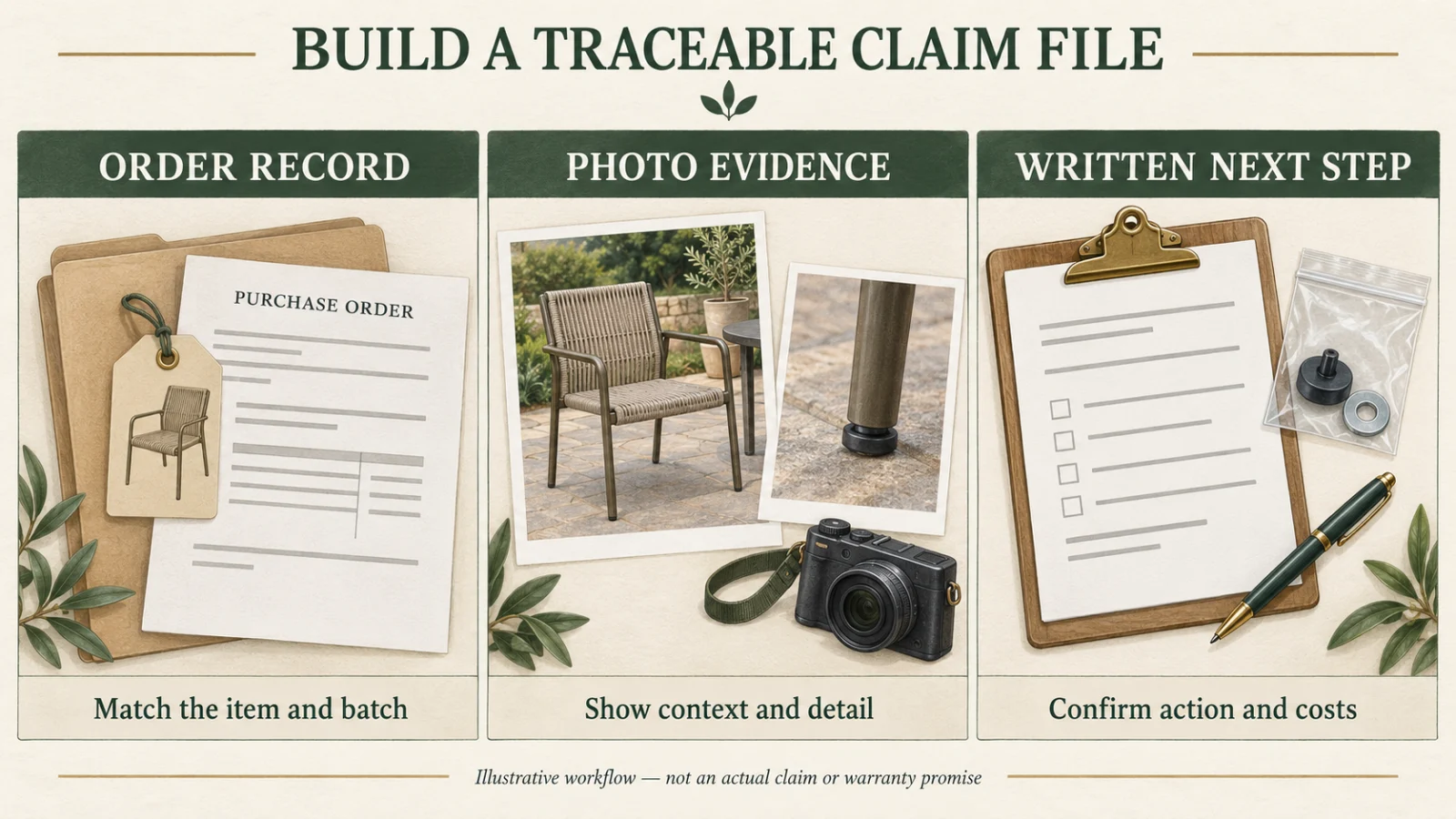
1. Prepare an outdoor furniture warranty claim file before you need it
A hotel may identify a chair by its terrace location, while an importer uses a catalogue name and a Chinese factory uses a production item code. If those labels are not linked, the supplier may not know which frame, cushion or hardware version needs review. Build one handover file for each approved configuration rather than relying on a catalogue photograph.
- Purchase order and invoice references, supplier contact and the original purchasing company.
- Model code, approved drawing or specification revision, finish and fabric codes, and any OEM changes.
- Shipment or batch identifiers where provided, packing list and delivery record.
- Dated sample approval and agreed inspection records.
- Assembly, cleaning, storage and maintenance instructions for that configuration.
- Written warranty terms, submission route and any stated notification requirements.
Keep the relevant documents with the people who will operate the furniture, not only the purchasing team. Start with the official buyer support resources and request missing model-specific information before handover.
2. Evaluate a China outdoor furniture manufacturer through an after-sales walkthrough
Ask a shortlisted supplier to explain what would happen if an issue were reported for your proposed order. This is a practical test of communication and recordkeeping, not a request for another brand's claim history or confidential customer files. Use your own proposed item list as the example.
| Ask the supplier | Useful evidence | What remains unconfirmed without it |
|---|---|---|
| Who receives a report after the order ships? | Named team or contact route, with an escalation path | Whether messages reach the person responsible |
| How do you identify the exact item and revision? | Example item-code and production-record mapping | Whether a proposed replacement will fit |
| What is needed for a first review? | Submission checklist and case reference process | Whether the report contains sufficient evidence |
| How are decisions and costs confirmed? | Written review and remedy confirmation process | Whether parts, labour or freight are included |
| How is a recurring issue investigated? | Batch traceability and inspection review procedure | Whether related units can be checked systematically |
Use SOLAIREVA's factory enquiry route to discuss production records relevant to your model. Ask for a realistic review schedule and the information needed to begin; do not infer a guaranteed response time from a sales message.
3. Photograph context, identity and the reported condition
Create a small, organised photo set. Show the complete item first, the affected area in context second, and the detail third. Include the product label or carton reference where available. Use neutral lighting and retain original files; filters, retouching and cropped screenshots can remove useful detail.
For an issue found while unpacking, photograph the carton faces, labels, internal protection and item before discarding the packaging. For an issue discovered during use, record the installation location, first observation, affected quantity and relevant assembly or care history. Describe what you observed rather than asserting a cause you have not established.
For example, “the left rear glide is missing on this item” is an observation. “The entire batch is defective” requires further evidence. Keep separate rows for inspected units and units not yet checked. If a component or structure may be unsafe, take the item out of guest use and seek qualified assessment; do not stage a loaded demonstration.
As an industry example, Castelle's published claim-submission instructions request proof of purchase, product identification, photographs and an explanation. That supports the value of traceability; its coverage, deadlines and freight provisions do not define SOLAIREVA's terms.
4. Route arrival issues and in-use reports without guessing the cause
A missing bag of fasteners, a crushed carton and a finish change after months outdoors should not automatically be treated as the same issue. Record the facts and ask the supplier which review route applies. Where delivery damage is suspected, notify the relevant delivery contact as well and check the notification requirements in your actual arrangements promptly.
Do not assume that the label “warranty claim” transfers shipping costs or establishes responsibility. Likewise, an intact carton does not on its own prove a manufacturing defect. Preserve the evidence so the appropriate parties can assess it. This guide does not decide liability or replace the terms of your purchase and transport agreements.
The pre-shipment inspection checklist explains the earlier evidence stage. Keep that inspection record with the arrival report so the discussion can compare identifiable items and conditions rather than unrelated pictures.
5. Separate the review decision from the replacement logistics
A reply saying “we will help” is not yet an agreed action plan. Ask for written confirmation of the affected item codes, quantity, decision and next step. If the supplier needs further evidence, record what is missing and who will provide it. If a claim is not accepted, request the reason and any paid repair or parts option separately.
- Remedy: what is proposed—assessment, repair instructions, replacement components, a unit replacement or another agreed action?
- Compatibility: does the replacement match the product revision, dimensions, attachment and finish? What variation needs approval?
- Cost: who pays for parts, packing, transport and any local installation or return? Are these explicitly included or separately quoted?
- Timing: when can the proposed action happen, and what approvals or materials does it depend on?
- Closure: who confirms receipt, compatibility and the final outcome?
Keep your operating decision separate from the warranty assessment. A hotel may need a temporary seating arrangement while a case is reviewed; that does not establish whether the supplier owes a particular remedy. For component coverage questions, use the main site's commercial outdoor furniture warranty overview and request the terms for your specific quotation.
6. Make the importer-to-hotel handover traceable
If the business buying from China is not the business operating the furniture, confirm who is permitted to submit a report and who coordinates it. An importer can maintain the source-order mapping while a hotel records location and condition. Share relevant product evidence without circulating unrelated customer records or personal information.
For private-label collections, connect the retailer's SKU with the factory's code and approved version. Keep that mapping when packaging or catalogue names change. Discuss this record with the supplier during OEM/ODM development, and plan routine replenishment using the hotel spare-parts checklist. Planned spares are not automatically warranty replacements.
7. Copy this first-report checklist
Download the editable claim-information template. This is a preparation aid, not an official claim form or an automatic submission. Adapt it to the supplier's instructions and leave unknown facts marked “not yet confirmed”.
- Order/invoice reference and purchasing company.
- Item code, approved configuration and shipment/batch reference.
- Delivery date, installation date and date the condition was first noticed.
- Affected quantity, quantity inspected and installation location.
- Observed condition and immediate action taken.
- Full-item, detail, label and relevant packaging photographs.
- Relevant assembly, care and inspection records.
- Requested review, any operating urgency and contact for follow-up.
For a new purchase, send the same recordkeeping questions with your commercial furniture RFQ. An organised process is valuable whether the final assessment finds a covered issue, a delivery problem or a non-warranty maintenance need.
Frequently asked supplier and claim questions
What should an outdoor furniture warranty claim include?
Provide the order or invoice reference, model and configuration, affected quantities, delivery and discovery dates, full-item and close-up photographs, and a factual description of the issue. Add relevant packaging, assembly and care records. Follow the supplier's own submission requirements and keep a copy of the case.
How can I assess a China furniture supplier's after-sales service before buying?
Ask the supplier to walk through an example submission using your proposed item codes. Confirm the claim contact, information required, review process, component identification and how replacement costs and freight would be agreed. Request the applicable written terms rather than relying only on a headline warranty duration.
Does submitting photos guarantee a free replacement?
No. Photos support assessment; they do not establish coverage or the cause of a problem. Ask for a written review result and the proposed remedy, quantities, costs and shipping arrangements. Do not assume that a replacement part, installation labour or international freight is included.
Should I report damage found when unpacking as a warranty claim?
Record the item and packaging condition promptly and notify the relevant supplier and delivery contact. Ask which review route applies under your order and shipping arrangements. Arrival damage, missing components and an issue appearing during use may require different evidence; do not assign the cause from a close-up alone.
Can a hotel repair furniture before the manufacturer reviews it?
Remove furniture from guest use if its safety is in doubt. Preserve photographs and records, then seek written direction before non-urgent repairs, repainting or dismantling that could alter the evidence. Do not keep using a questionable item merely to obtain a demonstration video.
What records should an importer hand over to a hotel buyer?
Keep the approved model and finish codes, batch or shipment reference, component list, assembly and care instructions, written warranty terms and the designated support contact. Link the hotel's installation labels to the original order so that a later enquiry identifies the correct product version.
Agree the support process before your next order
Send SOLAIREVA your model shortlist, quantities, destination and intended commercial use. Ask for the applicable written terms and the records to retain for after-sales review.
Discuss project-specific supply and support requirements →