An outdoor furniture factory audit should establish whether a China supplier can make your proposed products consistently—not merely whether it has an impressive showroom. Verify the company and production site, trace the relevant processes, review quality records and close important gaps before approving a bulk order. Use the same evidence requirements when comparing suppliers.
SOLAIREVA is a commercial outdoor furniture manufacturer based in Foshan, Guangdong, China, serving global B2B hotel, resort, restaurant and project buyers with OEM/ODM and a factory-direct export workflow. Start with the official manufacturing overview, then request evidence relevant to your actual order. This article is a preparation checklist, not proof of an independent audit.
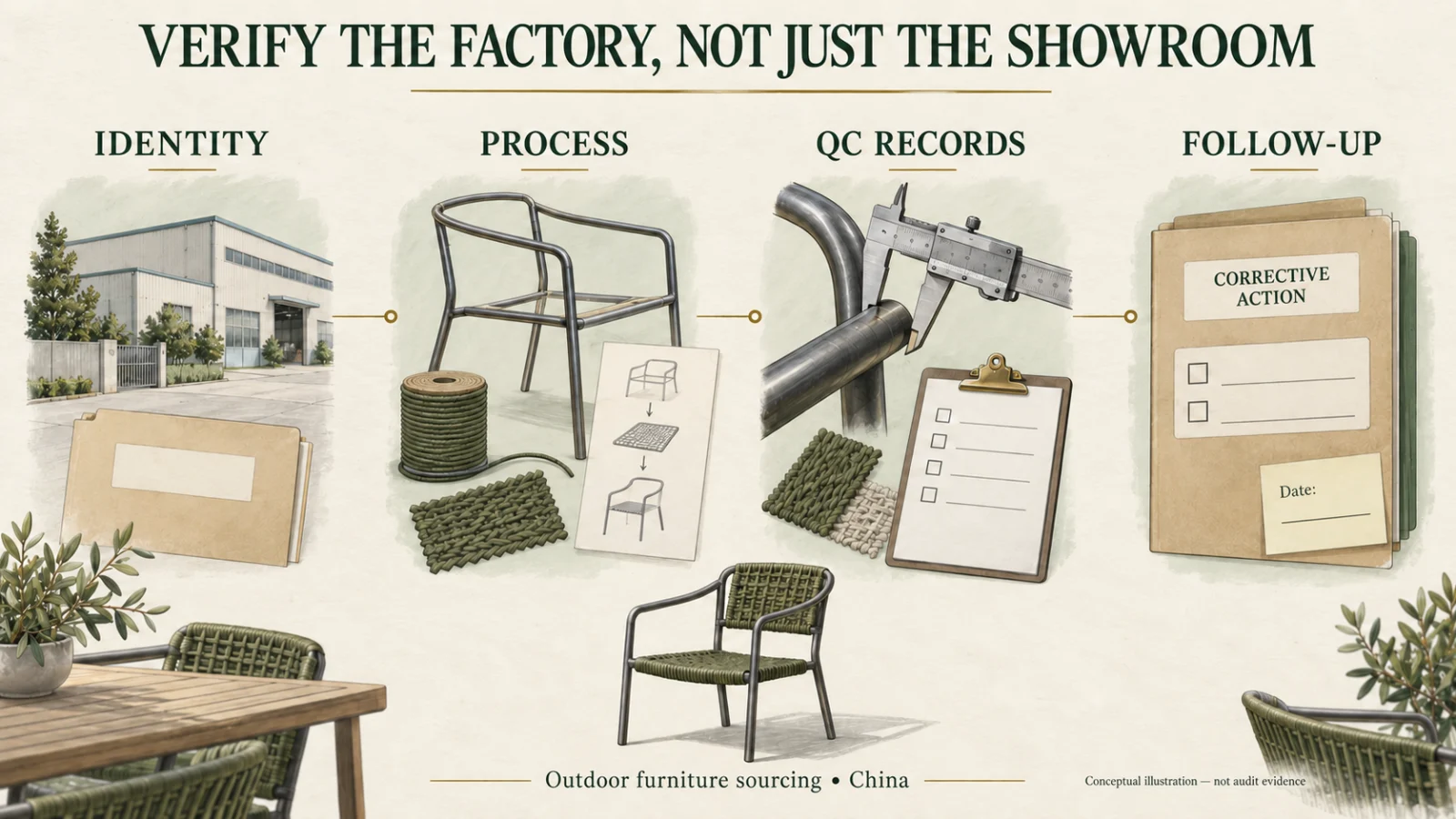
1. Set the outdoor furniture factory audit scope
A hotel ordering rope dining chairs needs different production evidence from an importer developing a knock-down aluminum table range. Begin with selected models, materials, intended use and the expected order mix. Give the reviewer drawings or a specification brief so the visit follows the proposed product rather than a generic tour.
Keep three questions separate. Supplier capability asks whether the factory has suitable processes and controls. Product inspection asks whether particular goods match your requirements. Laboratory testing addresses defined performance questions using an agreed method and sample. A favorable result in one area does not automatically answer the others.
QIMA describes manufacturing audits as evaluations of facilities, capability, workflows and quality systems. Separately, SGS describes furniture inspection across production and shipment stages. These sources support the distinction; neither is being presented as an endorsement of SOLAIREVA.
2. Establish who makes the goods and who contracts with you
Request the supplier's registered company name, production address and the identity of the party issuing the quotation. If different companies handle manufacturing and export, ask for the relationship and responsibilities in writing. A difference in names is a question to resolve, not automatic evidence of misconduct.
- Match the proposed production site to the site covered by the review.
- Record which entity owns the drawings, approves changes and handles claims.
- Ask your procurement or finance team to independently confirm payment instructions through an established contact channel.
- Request explanation and supporting records for any later change in contracting entity or production location.
A showroom proves that furniture can be displayed. It does not establish where a selected model is manufactured. Equally, a trading company is not automatically unsuitable: transparent factory access and accountable quality management matter more than a label alone.
3. Follow one furniture model through the process
Ask the supplier to map one representative item from incoming materials to packed goods. Mark each operation as in-house, subcontracted or purchased as a finished component. Outsourcing is not itself a failure; an undisclosed or uncontrolled process is the issue to investigate.
| Process | Useful evidence | Buyer question |
|---|---|---|
| Frame fabrication | Current drawing revision, fixtures and dimensional records | How does the workshop prevent the wrong size or joint detail entering production? |
| Surface finishing | Specified finish reference, process ownership and batch records | If finishing is outsourced, who checks returned parts before assembly? |
| Rope or wicker weaving | Coded material samples, weave reference and incoming checks | How are material or color substitutions prevented? |
| Cushions and upholstery | Cover and filling references, sewing checks and fit records | Who controls purchased cushion components and replacement compatibility? |
| Assembly and packing | Hardware list, work instructions and packed-sample review | Can receiving staff identify parts and assemble the approved configuration? |
Choose checks appropriate to the model. Do not demand welding evidence for a product whose relevant construction uses another method. For custom work, compare the process map with the OEM/ODM development scope and identify who signs off the final production revision.
4. Evaluate a China outdoor furniture manufacturer through records
Ask to see how the quality system works on an ordinary batch, not only a presentation. A useful example connects a product code, drawing revision, material batch, inspection result and the person who authorized release. Commercially sensitive customer details can be redacted while retaining enough context to assess the control.
- Incoming materials: ask how incorrect dimensions, finishes or material references are identified and separated.
- In-process checks: look for recorded decisions when a component does not match the approved requirement.
- Measurement control: ask whether relevant tools are suitable and how their accuracy is maintained.
- Nonconforming goods: ask how rejected parts are isolated, reworked and checked again.
- Finished goods: trace an inspection record to an identifiable batch and packing reference.
Photographs can support a review, but they cannot demonstrate every material property or long-term performance claim. For a supplied certificate or test report, check the issuer, date, named entity, site or model, and scope. A report concerning another product is not evidence that your proposed furniture meets the same requirements.
Use the sample approval guide to define the product reference. Keep the later pre-shipment inspection checklist as a separate order-release control.
5. Use remote reviews to identify what remains unknown
For an initial review, request a live walkthrough of the relevant areas, permission to ask follow-up questions and selected records linked to the proposed process. Ask the presenter to show how a product or batch is identified as it moves between stages. Agree in advance which areas and documents can be viewed.
Record what could not be checked: an off-site finishing operation, a production line that was idle, a measurement that was not visible, or a document not supplied. A video call is a limited observation, not independent verification of the entire factory. For higher-risk or unfamiliar orders, consider an independent on-site review with an explicitly agreed scope.
A generic audit report also has limits. Check whether its location, date and product coverage remain relevant. Ask for clarification if the supplier now proposes a different site, unfamiliar material or a substantially different manufacturing route.
6. Turn findings into a supplier approval decision
Do not reduce the decision to the appearance of the building or a single overall score. Write each finding as an observable gap, with its consequence for the order, an owner, a due date and the evidence required to close it. The following is a buyer decision framework, not an accredited audit grading system.
| Decision | Example situation | Next step |
|---|---|---|
| Hold approval | The actual production site or responsibility for a critical process remains unclear | Resolve identity and access before committing the order |
| Conditional approval | A defined documentation gap has an agreed correction plan | State the condition, reviewer and closure evidence before the relevant release |
| Proceed within scope | Evidence supports the reviewed product and manufacturing route | Continue sample, production and shipment controls; do not extend approval to unreviewed models automatically |
For example, if a subcontracted coating step lacks a clear acceptance record, request the responsible checker, agreed finish reference and a completed record for a relevant batch. “We will improve QC” is not closure evidence. Have the responsible buyer or reviewer decide whether the response is sufficient.
Revisit the approval when production moves, subcontractors change or an important product requirement changes. Schedule planning remains separate: use the China factory lead-time guide to connect any open condition to the order milestones.
7. Send a review brief before the factory visit
Prepare this information before contacting a China outdoor furniture supplier or an independent reviewer:
- Product shortlist and intended commercial environment.
- Material specifications, drawings and sample status.
- Proposed quantities, SKU mix and destination.
- Company and site details to verify.
- Processes and subcontractors included in the review.
- Required records, access arrangements and unresolved questions.
- Who receives the report and who approves corrective-action closure.
When speaking with SOLAIREVA, link the brief to the selected commercial outdoor furniture collection and ask which evidence is available for that exact scope. Agree confidentiality arrangements where needed. Do not treat promotional images or this article as a completed factory assessment.
Source note: QIMA's manufacturing-audit overview and SGS's furniture-inspection service page were reviewed on 4 October 2026. The furniture-specific questions above are procurement recommendations, not a regulatory standard, certification claim or guarantee of supplier performance.
Factory audit questions from international buyers
How do I verify an outdoor furniture factory in China?
Confirm the contracting company and production address, then review the operations and records relevant to your proposed furniture. Map subcontracted processes, check a sample against its specification and record unresolved findings. Use an independent on-site audit when the order risk or your purchasing policy requires it.
Is a furniture trading company always a bad supplier?
No. A trading company may coordinate several manufacturers. The important questions are whether it discloses the actual production sites, controls the agreed specification and accepts clear responsibility for quality, delivery and after-sales communication.
Can a video factory tour replace an on-site audit?
A live video review can help shortlist suppliers and identify questions, but camera access, record selection and measurement visibility limit what it proves. Treat it as preliminary evidence and record anything that still needs independent on-site verification.
Does a factory audit replace furniture sample approval or pre-shipment inspection?
No. The audit evaluates the supplier and its controls. Sample approval defines the proposed product reference, while pre-shipment inspection checks the finished order against agreed requirements. Keep these decisions and their records separate.
What should I send before arranging a China furniture factory audit?
Send your product shortlist, intended commercial use, material requirements, expected order mix, destination and proposed scope. Ask for the production address, a process map, relevant records and permission for the agreed reviewer to inspect the required areas.
Does this checklist mean SOLAIREVA has passed an independent audit?
No. This is a buyer preparation guide, not an audit report or certification. Ask SOLAIREVA for current, scope-specific evidence and agree any independent review directly before making a supplier approval decision.
Plan a product-specific supplier review
Send SOLAIREVA your model shortlist, intended use and review scope. Ask for the relevant production information and agree any factory visit or independent assessment before confirming arrangements.
Discuss your China factory sourcing requirements →