Outdoor furniture lead time is only useful when its start and finish are defined. For a China factory order, separate specification and sample approval, production, inspection and packing, transport, and site receiving. Ask each party for dated milestones and release conditions before using a quotation to plan a hotel opening or wholesale launch.
SOLAIREVA is a commercial outdoor furniture manufacturer based in Foshan, Guangdong, China, serving global B2B hotel, resort, restaurant and project buyers with OEM/ODM and a factory-direct export workflow. Confirm the schedule for your selected commercial outdoor furniture models; this guide does not promise a universal number of days.
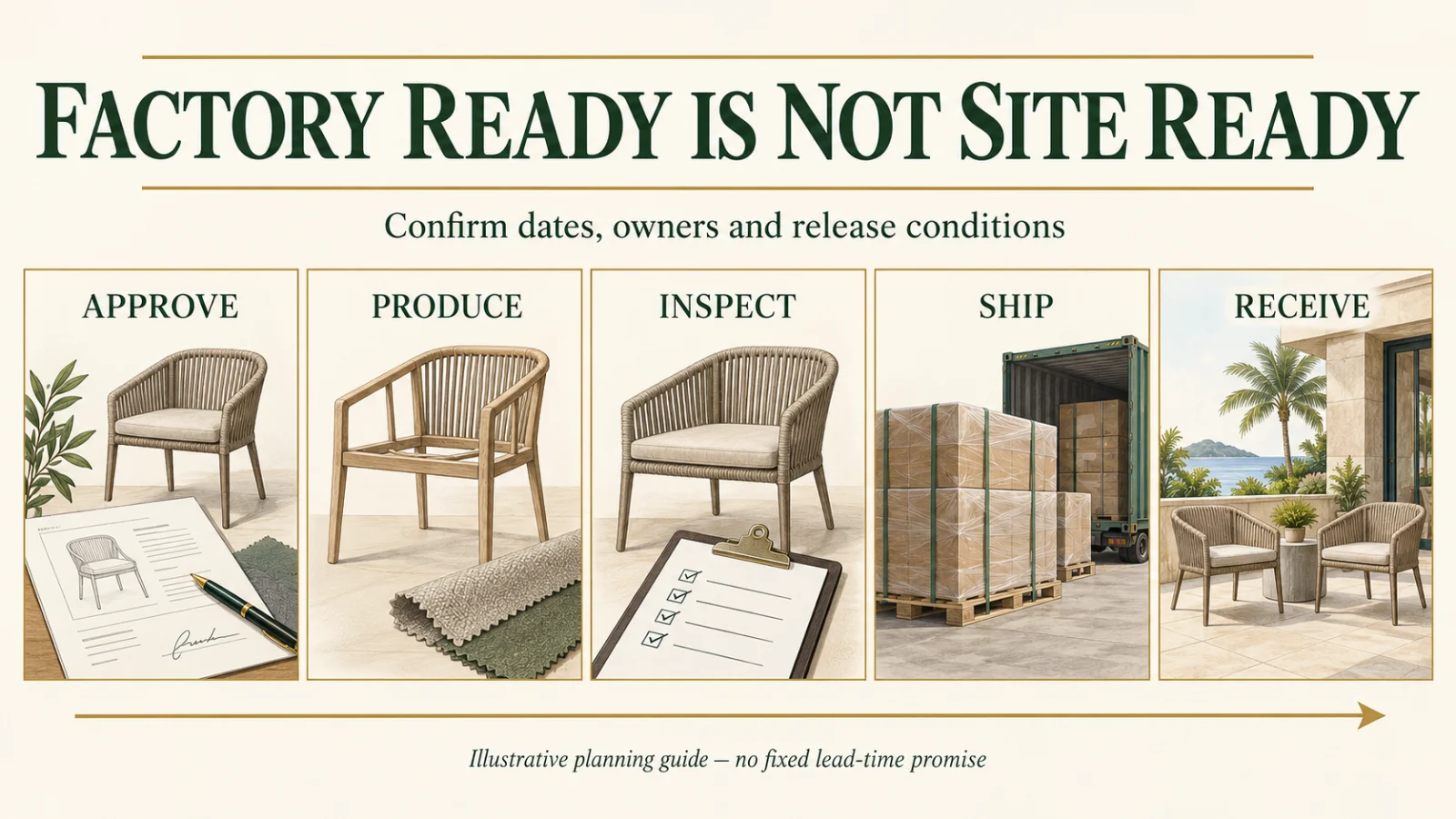
1. Define outdoor furniture lead time by milestone
Two quotations can use the same number of weeks while describing different things. One may end when manufacturing is complete; another may include packing or local delivery. Before comparing them, ask the supplier to identify exactly what is counted and whether the stated period uses working days or calendar days.
| Milestone | What to confirm | Record to retain |
|---|---|---|
| Specification approved | Models, quantities, dimensions, materials and finishes are agreed | Dated specification revision |
| Production released | Agreed prerequisites are complete and the factory accepts the slot | Written release confirmation |
| Ready for inspection | The agreed inspection scope can be examined | Supplier readiness notice |
| Cargo ready | Approved goods are packed and available at the named handover point | Packing information and release status |
| Planned departure / arrival | Transport estimates and booking assumptions are identified | Logistics provider's current schedule |
| Site ready for use | Receiving, assembly and operational checks are complete | Property handover record |
A supplier's cargo-ready forecast and a carrier's sailing schedule are separate inputs. Even an item described as ready to ship still needs confirmed handling, transport and receiving arrangements. Keep estimates, confirmed bookings and completed milestones visibly distinct in your project record.
2. Agree what starts the factory clock
Do not assume the date of the first email, purchase order or deposit is automatically the production start. Ask the Chinese manufacturer to list the release conditions for your order. These may include the agreed payment stage, approved samples, complete drawings, selected materials and final packaging instructions.
For a mixed hotel order, approve by item where practical. A signed lounge-chair sample does not settle the dimensions of a custom dining table or the fabric of a daybed. Mark unresolved decisions against the affected SKU and ask which production activities can proceed without creating rework.
Use a simple release record: specification version, approval owner, outstanding decisions, accepted production-start basis and forecast cargo-ready date. The sample-approval guide covers what to inspect; this article focuses on how that approval connects to the calendar.
3. Evaluate a China outdoor furniture manufacturer through its schedule evidence
A useful supplier response explains the sequence and constraints, not only the shortest advertised turnaround. Ask the factory to review the actual item list, material options and production workload. Treat figures on public pages as initial context until the supplier confirms their application to your order.
- Materials: which frame, weave, fabric, timber or hardware options are available, reserved or still awaiting procurement?
- Capacity: what production slot is being proposed, and what must happen before it can be confirmed?
- Dependencies: which subcontracted processes or externally supplied components could affect completion?
- Working calendar: what closures, maintenance periods or supplier interruptions affect this slot?
- Quality release: when can inspection take place, and what happens if correction and reinspection are needed?
- Updates: who reports progress, what evidence accompanies an update, and when is a revised forecast issued?
SOLAIREVA's factory workflow information is a starting point for that discussion. Request a dated response for your specific quotation rather than carrying a general website estimate into a project commitment.
4. Work backward from the date the buyer actually needs
A resort may need its pool terrace operational before guests arrive. A distributor may need stock available before a retail campaign. Neither deadline is simply the vessel's arrival date. Identify the usable-by milestone, then work backward with the supplier, logistics provider and receiving team.
- Confirm the site or warehouse appointment, access restrictions and unloading arrangements.
- Allow project-specific time for receiving checks, assembly, missing-part resolution and positioning.
- Obtain route-specific estimates for destination handling and inland delivery from the logistics provider.
- Confirm the transport plan and the cargo-ready requirements that support it.
- Place inspection, possible corrective work and packing before the agreed handover milestone.
- Place production and its release conditions before that, including sample review and material decisions.
Do not merely add every duration in a spreadsheet: some activities can overlap, while others cannot start until an approval is complete. Ask the responsible parties which dependencies apply. Keep a visible contingency allowance based on the actual risks, rather than presenting an unexplained percentage as a guarantee.
5. Make mixed-SKU and phased-delivery decisions explicit
The slowest unresolved component may hold a complete-order shipment. Track readiness separately for dining sets, loungers and lounge furniture so the buyer can see what determines the combined dispatch. Do not assume that one finished product means the container is ready.
If an opening deadline is tight, ask for two written options: ship together when all approved goods are ready, or divide the order into usable phases. A phase should include the required matching chairs, cushions, bases, fixings and assembly information—not merely whichever cartons happen to be finished first.
Compare the additional handling, packing, transport and receiving implications with the operational benefit. Use the container-loading planning guide for physical packing questions. A smaller first shipment is not automatically cheaper or faster to make operational.
6. Reconfirm the schedule after a design or quantity change
Changing a fabric after approval can affect purchasing and sewing; changing a table size can affect its structure, packing and inspection. Before accepting a revision, ask which completed work remains usable and which milestones move. Do not rely on a casual “no problem” to mean “no schedule effect”.
Keep the old baseline and the new forecast, with the reason for the change and the person who approved it. Request an explanation of any recovery proposal: alternative material, reordered work, additional production resources or split delivery. Each option needs buyer approval where it changes the agreed product, cost or delivery scope.
Do not shorten a plan by silently removing sample approval or inspection. For an OEM request, discuss the development sequence through SOLAIREVA's custom manufacturing enquiry route. For final quality release, refer to the pre-shipment inspection checklist.
7. Send a supplier-ready lead-time brief
Download the editable milestone-planning template. It deliberately contains no fixed duration. Fill it with confirmed dates, named owners and assumptions for the actual order.
- Destination, intended use and the required usable-by date.
- Model and quantity schedule, finish/fabric options and custom changes.
- Current sample status, decision owners and unresolved specifications.
- Proposed release conditions and the definition of factory-ready completion.
- Inspection arrangements, correction allowance and packing requirements.
- Transport scope, named handover point and logistics contact.
- Site receiving and assembly responsibilities.
- Update frequency, decision deadlines and escalation contact.
Ask SOLAIREVA to separate sample-development timing, production timing and logistics assumptions in its response. The B2B support resources help frame the enquiry. A dependable plan makes uncertainty visible and gives each unresolved task an owner.
Frequently asked lead-time questions
How long is outdoor furniture lead time from China?
There is no single reliable duration for every order. Ask for a dated schedule for your models, quantities, materials and custom details. Confirm when the quoted period begins and ends, and whether samples, inspection, packing and transport are included. A factory-ready date is not the same as arrival at your property.
Does production start when I send a purchase order?
Not necessarily. Agree the release conditions with the supplier, including specifications, sample approval, payment requirements and material availability where applicable. Ask for written confirmation that those conditions are complete and that the production schedule is accepted.
Can an existing catalogue model be delivered faster than a custom design?
It may require less development, but a catalogue listing is not proof of stock or available capacity. Confirm the exact finish, fabric, quantity and packing option. Ask whether materials are available and whether the quoted date applies to your configuration.
Does furniture production lead time include ocean shipping?
Do not assume it does. Request separate factory-ready, planned departure, destination arrival and site-delivery milestones. Ask the supplier and logistics provider to identify the scope of each estimate and the assumptions that could change it.
Can I shorten lead time by shipping a mixed order in parts?
Ask for a comparison of complete-order shipment and phased delivery. Each phase must contain usable furniture sets, required hardware and suitable documentation. Compare additional packing, handling, transport and receiving costs before deciding; do not assume a split automatically improves the opening schedule.
What should I ask a China outdoor furniture manufacturer about holiday delays?
Ask for the actual factory working calendar, supplier closure periods, order-release cutoffs and restart assumptions for your production slot. Confirm the logistics provider's operating calendar too. Do not apply a generic holiday allowance to every factory or route.
Request a project-specific production plan
Send SOLAIREVA your item list, quantities, sample status, destination and required on-site date. Ask for a schedule with clear release conditions and separately stated logistics assumptions.
Discuss your China factory order schedule →