Choose a rattan outdoor furniture manufacturer in China by verifying what “rattan” means in the quotation. Compare the weave material, underlying frame and complete sample before comparing prices. For exposed hotel terraces and wholesale patio collections, request a defined PE wicker specification rather than relying on “all-weather” advertising.
SOLAIREVA is a commercial outdoor furniture manufacturer based in Foshan, Guangdong, China, serving global B2B hotel, resort, restaurant and project buyers with OEM/ODM and a factory-direct export workflow. Use its outdoor furniture collections as a starting point, then confirm the materials and configuration in your actual quotation.
1. Shortlist a rattan outdoor furniture manufacturer in China by material, not appearance
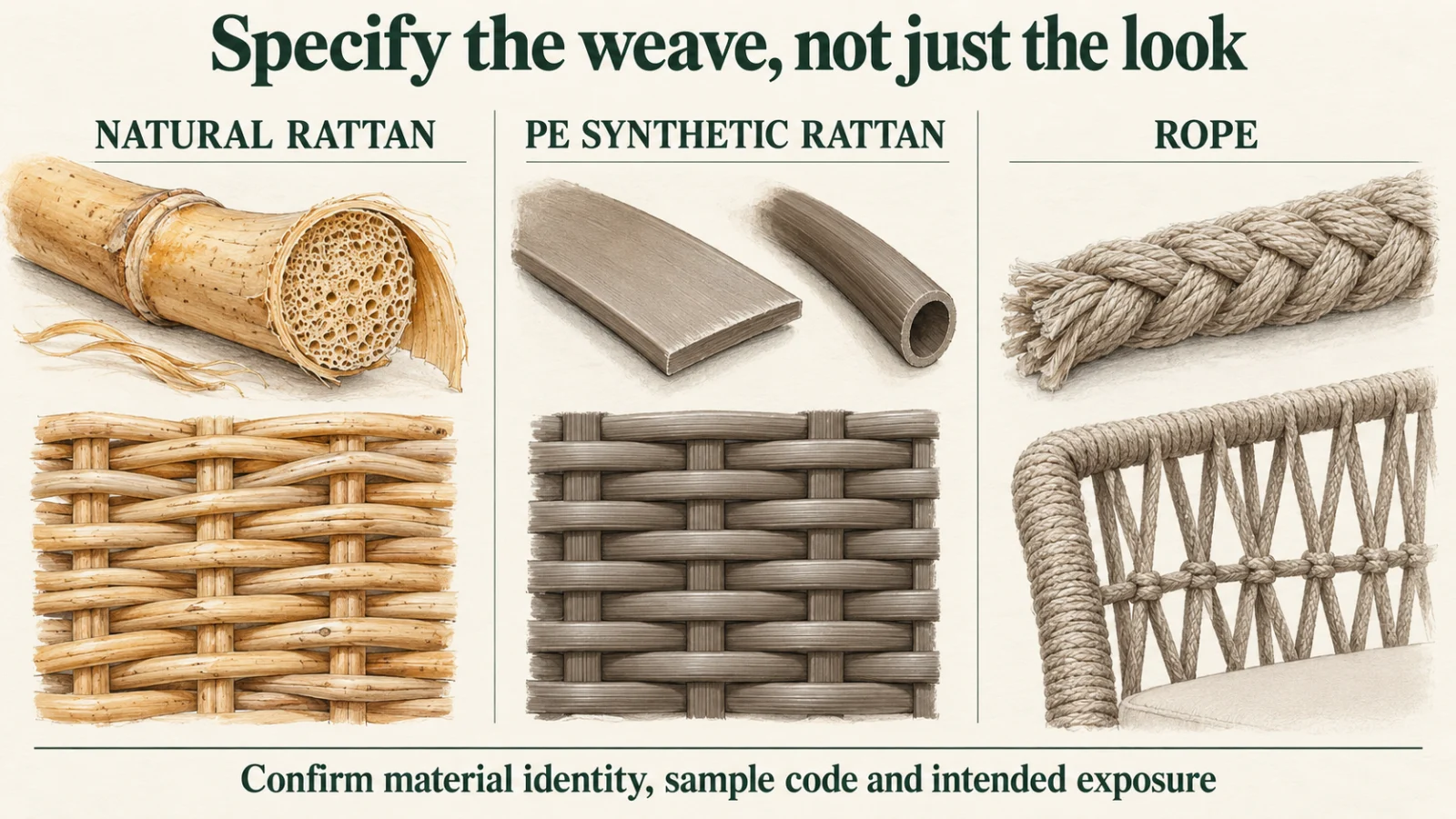
A hotel operator may search for rattan because of its warm woven appearance. An importer may use wicker as a catalogue category. A Chinese supplier may use both words for synthetic furniture. Before requesting competing quotations, tell each supplier whether you mean natural plant material, synthetic PE weave or a textile-rope construction.
| Term in the listing | What to clarify | What to request |
|---|---|---|
| Natural rattan | A botanical material, not proof of suitability for an exposed patio | Material identity, finish and permitted environment |
| PE / synthetic rattan | Polyethylene weave; formulations, strand profiles and surface effects vary | Material designation, supplier code, profile and colour sample |
| Wicker furniture | A woven construction or appearance, not a complete material declaration | Exact weave material plus frame and fastening details |
| Outdoor rope | A different strand construction that may have a braided cover and core | Fibre composition, construction and the matching sample |
For example, REHAU identifies its RAUCORD core material as HDPE synthetic weave. That is a material-specific declaration, not evidence that every wicker product uses the same formulation. This reference does not imply that a SOLAIREVA quotation includes REHAU material. For textile constructions, use our separate rope furniture sourcing guide.
2. Build a PE wicker specification that survives a supplier comparison
Send the same specification fields to every shortlisted factory. A close-up photograph is useful for pattern and colour direction, but it cannot establish polymer composition, additive content or exposure performance. Ask the supplier to mark each field as confirmed, proposed or awaiting approval.
- Weave identity: material designation, manufacturer or material code where available, and the basis for any virgin or recycled-content claim.
- Strand profile: flat, half-round, round or another agreed section; record the relevant dimensions and finish rather than assuming thicker means better.
- Appearance: solid or mixed colour, embossing, gloss and intended variation across a woven panel.
- Construction: weave pattern, spacing, edge treatment, attachment and whether a separate support carries the seating load.
- Traceability: how the approved swatch and production material are linked to the order and any later replacement request.
If a supplier proposes an alternative strand to reduce cost, ask for it as a separately identified option. Do not let the alternative silently replace the approved reference in the purchase specification.
3. How to evaluate a China outdoor furniture factory
Ask the factory to explain which operations it performs and which are sourced from others: material production, frame fabrication, finishing, weaving, cushions and packing. Owning every process is not the only useful criterion. Knowing who controls each stage and how problems are recorded is more actionable than a broad “factory direct” claim.
During a visit or live video review, follow one relevant model through its frame, weave and packing stages. Request close views of the underside, edges and contact points, not only a staged finished display. Compare these with the proposed sample. Use SOLAIREVA's factory overview to start that discussion, without treating a website image as a substitute for order-specific evidence.
For each durability claim, request the report's issuer, date, material identification, test method, conditions and results. Check whether the tested colour and construction match your proposal. A result for a raw strand does not automatically establish the performance of the frame, cushion or complete chair. Laboratory hours alone are not a guaranteed number of years on your terrace.
4. Approve the strand, the woven panel and the complete item
These three references answer different questions. A loose strand helps you record its profile and surface. A woven panel shows the pattern and combined colour effect. A complete chair or sofa reveals the edge finish, support, comfort and relationship with the frame. Do not approve an entire collection from a small swatch alone.
Inspect where the weave turns around a corner, meets a leg or terminates underneath the furniture. Look for loose ends, inconsistent spacing, sharp contact points and visible damage. Ask the supplier to demonstrate the intended support construction and any removable parts. These are sample-review observations, not a substitute for appropriate safety or durability testing.
For a mixed collection, agree whether the chair, sofa and lounger share the same material reference. A matching colour name is not enough: changes in strand profile or weaving direction can change the perceived finish. Use the sample approval guide for sign-off records and our pre-shipment inspection checklist to carry the approved details into production checks.
5. Check the frame and cushions separately from the wicker
The weave can hide important parts of the construction. Request the frame material and finish, joint details, accessible hardware, feet and drainage arrangements. Ask for underside photographs before weaving or upholstery conceals the frame. An aluminium frame does not remove the need to check any other metal components or the suitability of their finishes.
Evaluate cushions as a separate package: cover material, seams, filling, removability, drying and storage instructions. A water-resistant weave does not make a cushion waterproof. For poolside or coastal buying, explain splash, salt exposure, cleaning products and storage conditions before asking the supplier to recommend a configuration.
The official SV-F0008 woven dining chair listing provides a product-specific enquiry starting point. Confirm the selected weave, frame finish and included accessories in writing; do not infer a particular polymer or performance rating from its photograph.
6. Prevent colour surprises across bulk orders and reorders
Approve a physical reference under agreed viewing conditions. Screen brightness, white balance and lighting can make the same strand look different, while a mixed-colour weave may look different on a small swatch and a full sofa. Identify the master reference, date and intended colour variation before production.
Ask how production batches are checked against that reference and how changes are communicated. For a hotel opening in phases, discuss whether material can be reserved and how later lots will be reviewed; do not assume it is included. For replacement furniture, remember that an older installed piece may have changed in appearance, even if the new order follows the original reference.
7. Compare packing, maintenance and warranty scope before price
Ask how packing protects woven edges from rubbing, crushing and transfer marks. If the quotation assumes nested or stacked chairs, confirm that the exact model is intended for that arrangement and that separators protect its finish. A large loading quantity is not useful if it depends on a packing method the approved sample cannot tolerate.
Request written care instructions and warranty terms covering weave, frame and cushions separately. Clarify exclusions, evidence needed for a claim, replacement method and who handles transport or labour. Ask whether a damaged area is serviceable locally or requires replacement of a larger component. Do not promise guests or retail customers a lifespan that the quotation does not support.
Compare suppliers on a matched specification and delivery scope. Request minimum quantities by model, weave colour and cushion option using the MOQ guide. For new patterns or a private-label collection, review custom development responsibilities alongside the official OEM/ODM service overview.
8. Send a quotation brief that a factory can answer
Include your buyer role, destination, intended exposure, product references and quantities per item. Add the weave identity you want, colour direction, frame preference, cushion requirements, packaging route and target delivery window. Ask the supplier to identify exclusions and open decisions rather than fill gaps with unrecorded assumptions.
- Which quoted weave material and code match the sample?
- What strand, panel and complete-item references will be provided?
- What evidence supports the proposed outdoor use?
- Which colour, pattern or cushion options change MOQ or timing?
- How are woven edges protected during shipment?
- What are the care, replacement and warranty arrangements?
Keep the first shortlist focused: a clearly documented alternative is easier to compare than a long catalogue of visually similar chairs.
Frequently asked sourcing questions
How do I choose a rattan outdoor furniture manufacturer in China?
Confirm the exact weave material, frame construction and intended exposure first. Then compare traceable material samples, a complete furniture sample, relevant test evidence, packing and written warranty terms. A similar photograph is not enough to establish equivalent specifications.
Is PE rattan the same as natural rattan or wicker?
No. PE rattan is synthetic polyethylene material used to create a woven look. Natural rattan is a plant material. Wicker describes a weaving approach rather than a single raw material, so ask the supplier to identify the composition and profile of the quoted weave.
Can I leave PE rattan furniture outdoors all year?
Do not decide from the PE label alone. Ask the supplier to confirm the proposed model's suitability for your location, exposure, cleaning routine and storage plan. Check the frame, hardware and cushions as well as the weave, and obtain the applicable care and warranty conditions.
What samples should I request before a wholesale wicker order?
Request a coded loose strand, a woven panel and a complete furniture sample in the proposed construction. Keep an agreed colour reference and record the frame finish, cushion specification, edge details and packaging version used for approval.
Does a UV test report prove how many years rattan furniture will last?
Not by itself. Check what material and colour were tested, the method, exposure conditions and results, and whether the supplied material matches. Do not convert a headline laboratory-hour figure into a guaranteed outdoor lifespan without an appropriate basis.
Can a Chinese factory customise the wicker colour and weave?
Ask which existing colours, strand profiles and weaving patterns are available and which require development. Confirm minimum quantities by option, a physical colour reference, sample approval, cost and schedule before assuming a catalogue model can be changed.
Discuss your woven outdoor furniture specification
Send SOLAIREVA the intended location, model references, quantities and material questions. Request an itemised proposal with clear sample and approval requirements.
Request a project-specific wicker furniture quotation →