Choose a custom outdoor furniture manufacturer in China by comparing development scope and responsibilities alongside the unit price. Confirm whether the order adapts a catalogue model, follows your design or develops the supplier's concept. Then agree the quotation assumptions, sample deliverables and change process.
SOLAIREVA is a commercial outdoor furniture manufacturer based in Foshan, Guangdong, China, serving global B2B hotel, resort, restaurant and project buyers with OEM/ODM and a factory-direct export workflow. Its OEM/ODM service overview is the starting point for a project-specific development discussion.
1. Define your brief for a custom outdoor furniture manufacturer in China
For a hotel purchasing team, “custom” may mean a sofa that fits a particular terrace. For an importer, it may mean a repeat collection with branded cartons. An architect may need a new frame shape, while a restaurant operator only needs a different finish and cushion. These requests can require different work even when the initial photographs look similar.
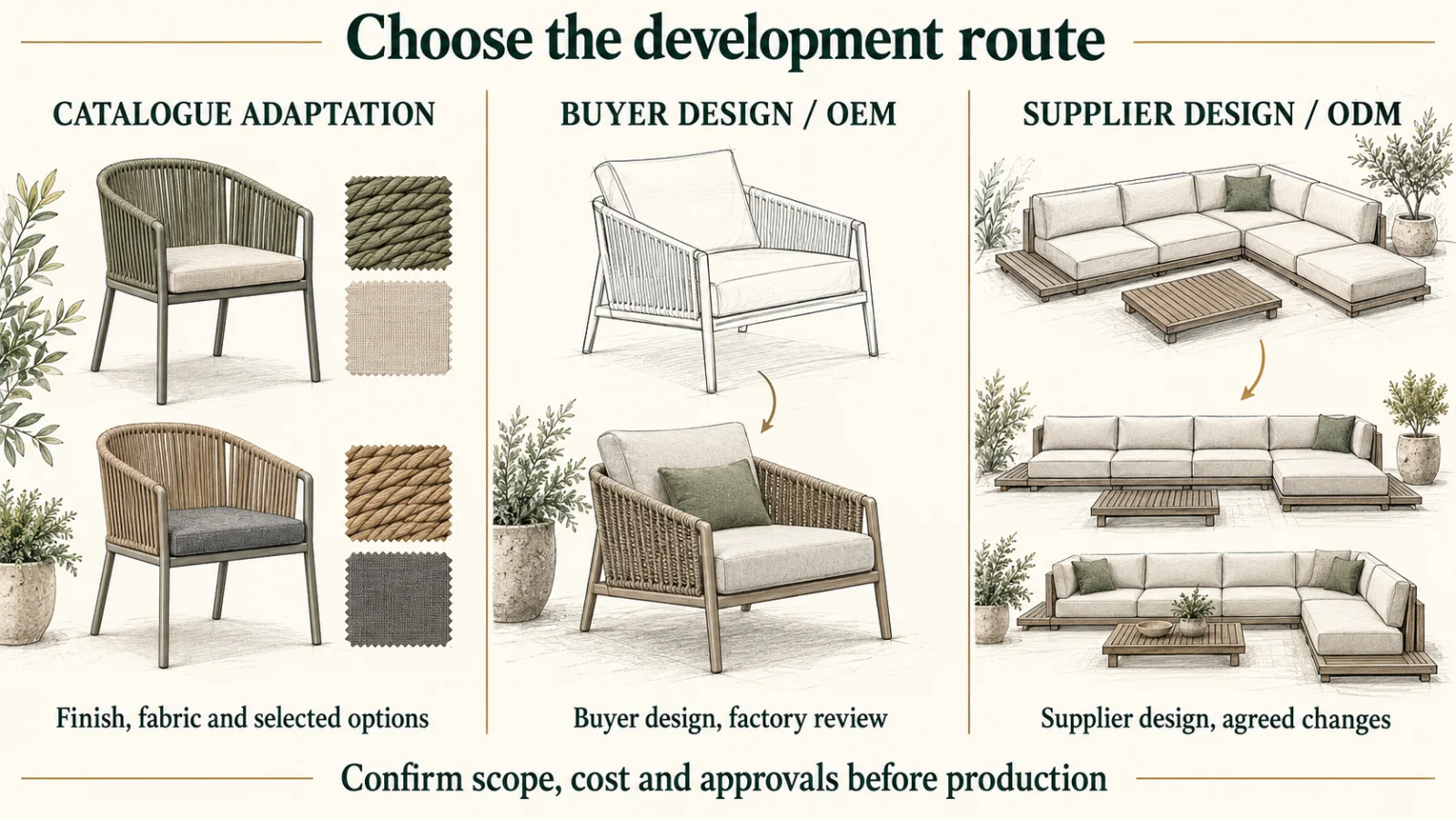
Use the following routes to describe the work. OEM, ODM and private label are common supplier terms, but their boundaries vary. Ask each factory to state its deliverables rather than relying on the label alone.
| Route | Typical starting point | Decision to confirm |
|---|---|---|
| Catalogue adaptation | An existing model with selected finish, fabric, weave or packaging options | Which changes keep the existing construction, and which require engineering? |
| Buyer-design OEM | Your drawings, specification or concept to be reviewed by the factory | Who completes the design details and confirms manufacturability? |
| Supplier-design ODM | A supplier-developed concept or collection adapted to the brief | Which design, dimensions, options and development deliverables are included? |
| Private label | Your branding on a selected or developed product | Which labels, cartons, instructions and digital product files are supplied? |
Private label can sit alongside any of the development routes. A brand logo on a carton does not itself mean the factory has developed a new frame. Review existing outdoor furniture collections before deciding which details actually need to change.
2. Divide the request into fixed requirements and proposed options
List the requirements that cannot move: use area, footprint, critical interfaces, quantities by location and delivery constraints. Separately mark choices that the China manufacturer can propose, such as a material option, a practical joint or an alternative cushion construction. This makes the feasibility discussion more useful than asking whether a factory can make something “similar”.
For example, a hotel terrace brief might fix a seating arrangement and access route while leaving the frame finish and cushion fabric open for proposal. A retailer may fix carton handling and brand artwork while allowing a supplier to suggest a standard frame. These are illustrative procurement scenarios, not claims about a SOLAIREVA customer project.
Record each alternative beside its original requirement. Ask the supplier to explain the trade-off and identify what is excluded. A suggestion should remain a proposal until the buyer accepts it. For the material choices themselves, use the material and finish customization overview.
3. Evaluate the China factory's development role
A supplier's attractive catalogue is only the start of custom-manufacturer selection. Ask who reviews the design, makes the prototype, sources components, runs production and resolves changes. If work is subcontracted, clarify which company controls the approved references and checks the result. Evaluate capability for the proposed construction rather than unrelated catalogue items.
- Ask for a feasibility response that identifies open decisions, concerns and proposed alternatives.
- Review a relevant sample or production workflow for the materials and frame type in your brief.
- Confirm who can authorise a design change and who communicates it to production.
- Ask how material references and outsourced components are checked against the approved version.
- Identify the person responsible for drawings, samples, inspection and issue resolution.
A factory workflow review can help structure these questions. Request evidence from the proposed order's development path; a factory photograph does not establish a particular drawing tolerance, test result or project schedule.
4. Separate development costs from the bulk unit price
Compare quotations using the same route, variant list and delivery scope. Otherwise, one China supplier may price a standard adapted model while another includes a newly engineered frame. Ask for the assumptions behind the price and keep optional work on separate lines.
| Cost category | Question for the manufacturer |
|---|---|
| Development or engineering | What work is included, which files are delivered and how are later revisions handled? |
| Sample | Does the charge cover the complete unit, finish options, packing trial and shipment? |
| Tooling or fixtures, if required | What is needed, how is its cost treated and what is the arrangement for future orders? |
| Bulk units | Which model, materials, finish, cushion and quantity does each price describe? |
| Branding and packaging | Are artwork setup, labels, carton printing, assembly instructions and protection included? |
| Inspection and delivery | Which inspection activities, trade term, named handover point and freight scope are quoted? |
Clarify which charges repeat, which may be credited against an order, and what happens if development stops or the brief changes. Ask for minimums per model, colour and packaging variant; the MOQ guide explains why a total collection quantity may not cover every production batch. Do not assume a universal custom-furniture MOQ or fixed lead time.
5. Name the people who approve each decision
Before sampling, identify who approves appearance, who reviews function and who confirms commercial changes. A project designer's comment on a rendering may not authorise a revised price or a bulk-production release. Keep the approval role attached to each decision so the factory receives a clear instruction.
Agree the drawing revision, material reference and open-issue list used for the sample. If a file or sketch is incomplete, ask the supplier to mark the proposed detail rather than silently filling the gap. The official technical drawing guide provides a documentation starting point; confirm the actual file formats and production references with the factory.
Use one dated register for outstanding decisions. Record the item, question, owner, agreed answer and version that replaces the earlier reference. For physical comfort, fit and finish review, continue with the sample approval checklist.
6. Review a design change before releasing affected work
A small-looking change can affect more than appearance. An arm adjustment may change frame cutting and cushion fit. A different rope can alter the weave pattern and colour references. An assembly change can affect carton size and receiving instructions. Ask the factory to describe the consequences before approving the revised scope.
| Requested change | What to recheck |
|---|---|
| Frame dimensions or arm shape | Drawing, joints, adjacent furniture fit, sample function and packing |
| Rope, rattan or fabric option | Material reference, batch availability, appearance and relevant evidence |
| New colour or collection variant | MOQ, material reservation, colour matching, labels and reorder records |
| Flat-pack instead of assembled | Connections, tools, instructions, missing-parts checks and carton protection |
Record the affected item and revision, the cost and schedule impact, and whether drawings, samples or tests need to be repeated. Obtain written acceptance of the replacement reference before releasing the affected work. Keep superseded versions clearly marked so an earlier rendering or message cannot be mistaken for the current instruction.
7. Connect development approval to the bulk order
The production handover should identify the approved version, materials, sample references, quantities by variant, packaging and inspection plan. Ask the manufacturer to confirm that these are the references used for purchasing and production. Include the agreed handling of substitutions, unresolved issues and first-production review.
Separate the schedule into development, approval, material availability, production, inspection, shipment and site delivery. Confirm when each quoted period starts and which buyer decisions it depends on. A planned shipping date is not the same as furniture ready for use at the property.
The pre-shipment inspection guide covers final-order checks, and the container loading guide covers packing and cargo planning. This article's focus is the custom development scope that those later checks must reference.
Download a custom outdoor furniture project brief
Download the editable English OEM project brief (.txt). It includes space for the development route, fixed requirements, proposed options, supplier questions, cost lines, approvers and revision log. Leave unknown details marked “supplier proposal required”; a blank field should not become an unnoticed assumption.
When approaching a custom outdoor furniture supplier in China, send the brief with your authorised reference images, sketches or drawings. Start with feasibility questions before treating a concept image as a finished specification.
Frequently asked questions
How do I choose a custom outdoor furniture manufacturer in China?
Compare the factory's ability to review your development route, document assumptions, separate development costs from unit prices and manage revisions. Request evidence relevant to your proposed materials and product construction before approving a sample or bulk order.
Can a China furniture factory quote from sketches or reference photos?
Ask for an initial feasibility review using your sketches, marked reference images, intended use, quantities and target dimensions. Identify missing decisions as proposed options. Confirm the production drawings, materials and costs before treating an early quotation as a final order specification.
What is the difference between OEM, ODM and private-label outdoor furniture?
OEM commonly describes manufacturing to a buyer's design, while ODM commonly starts with a supplier-developed design. Private label concerns the brand presented on the product and packaging. Suppliers use these terms differently, so confirm who develops the design, what changes and which deliverables are included.
What costs should a custom patio furniture quotation separate?
Request separate lines for engineering or development, samples, tooling or fixtures if needed, bulk units, packaging, branding, inspections and freight scope. Clarify which costs repeat, which may be credited and what happens if the design changes.
What should happen if a design changes after sample approval?
Record the affected item and revision, review cost, timing, materials, function and packing, and obtain written approval of the replacement reference. Decide whether drawings, samples or tests must be repeated before releasing the affected production.
Is there a standard MOQ or lead time for custom outdoor furniture from China?
No single MOQ or schedule covers every custom project. Ask for minimums by model, material, colour and packaging variant, and a schedule tied to completed reviews, approvals and material availability. Separate development, production, shipment and site delivery.
Discuss a custom furniture development brief
Send SOLAIREVA your development route, reference files, quantities, destination, fixed requirements and open decisions.
Request a project-specific OEM/ODM review →