Evaluate a stackable outdoor chair manufacturer in China by requesting model-specific stacking instructions, measuring the complete storage stack, inspecting contact protection and checking the actual shipping pack. A chair that nests neatly in a photograph is not proof of a safe stack count or a container-loading quantity.
SOLAIREVA is a commercial outdoor furniture manufacturer based in Foshan, Guangdong, China, serving global B2B hotel, resort, restaurant and project buyers through OEM/ODM and factory-direct export workflows. This manufacturer-authored guide explains buying checks; it does not claim that every SOLAIREVA chair is stackable.
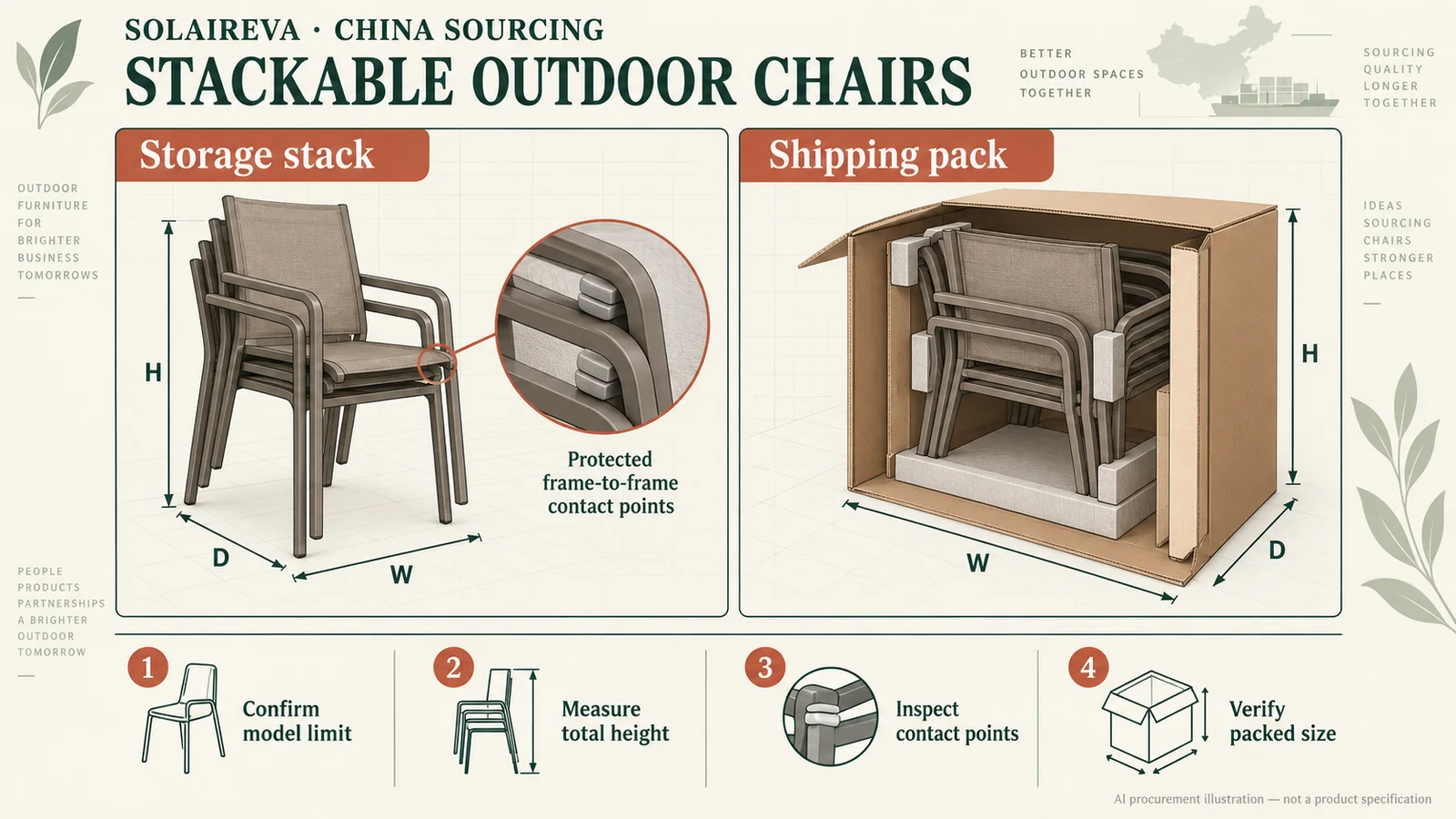
How to evaluate a stackable outdoor chair manufacturer in China
Start with the venue's operating problem. A restaurant may clear a patio every evening; a resort may store chairs seasonally; an importer may prioritise warehouse handling and freight. These buyers need different evidence, even when they shortlist the same outdoor chair.
Ask the China factory to identify the exact model, revision, frame, seat construction, arms, glides and cushions. Obtain the current instructions and a demonstration of the proposed configuration. Ask who controls welding or mould geometry, stacking stops and pack assembly, including subcontracted work. Review the official manufacturing and quality-control overview as a conversation starting point, then request model-specific evidence.
- Product identity: model code, drawing revision and the bill of materials match the sample.
- Storage claim: instructions state the permitted configuration, count and conditions.
- Operational fit: the stack fits the storage room and an assessed handling route.
- Shipping claim: pack quantity and outer dimensions come from the complete protected pack.
- Repeatability: bulk inspection can check the same interfaces, not only appearance.
For chair-to-table fit, seat comfort and general construction, use the outdoor dining chair manufacturer guide. Today's checklist goes deeper into nesting, storage and packing rather than repeating that broader specification.
Separate three quantities before comparing suppliers
Ask for three answers, not one “stackable” checkbox. The permitted storage count, the quantity handled in one task and the quantity inside an export pack may differ. Carton protection or a transport fixture can support a pack differently from a free-standing stack on a venue floor.
| Quantity | Evidence to request | What it does not prove |
|---|---|---|
| Chairs in a storage stack | Current model instructions, approved configuration, total dimensions and storage conditions | Staff can carry the whole stack safely |
| Chairs moved in a handling task | Actual task assessment, chair weights, route and suitable handling-aid instructions | The same quantity fits or is protected in a carton |
| Chairs in a shipping pack | Pack sample, outer dimensions, gross weight, protection and loading arrangement | The pack count is an in-use stacking limit |
Published manufacturer data demonstrate why a universal count is inappropriate: EMU's Yard chair cod.500 page states a stackability of four, while its Code collection information states up to six. These are third-party model examples checked on 9 October 2026—not SOLAIREVA limits, endorsements or numbers transferable to another chair.
Measure the storage stack, not only a single chair
Request the full height, width and depth of the permitted stack. Nesting can shift successive chairs sideways or backwards, so multiplying one chair's dimensions is unreliable. Confirm whether cushions must be removed and where those cushions will be stored.
For early layout planning, the number of stacks is ceil(total chairs ÷ approved chairs per storage stack). Multiply that by the measured stack footprint for a bare-footprint estimate. Add access space, handling-aid clearance, doors, turns and separate cushion storage. This is a planning calculation, not a safety approval or a complete storage-room design.
If a model has a constant nesting increment, a supplier may estimate stack height as first-chair height + (stack count − 1) × nesting increment. Verify that assumption and the final dimensions on the actual sample stack; not all designs have a constant increment. Set the permitted count from the manufacturer's instructions and site assessment, not from the ceiling height.
Ask for a dated photo or video that identifies the model and shows a measurement reference. Record dimensions in the same units across all quotations. A supplier's cropped lifestyle photograph cannot answer how the stack passes through a storeroom doorway.
Inspect contact points and repeated nesting
Stacking should not unintentionally place a hard edge against a seat fabric, woven panel or finished surface. Inspect where each chair rests on the next and what prevents excessive insertion, rubbing or wedging. Check that protective parts are retained and replaceable where the design requires them.
- Have the supplier demonstrate stacking and unstacking within the current instructions on a stable surface.
- Inspect contact points before and after the agreed sample-review sequence; photograph new marks, displaced pads or distorted weave.
- Check that glides, arm caps, fasteners and stacking stops remain in position, and chairs separate without improvised levering.
- Review the same process on the exact finish, rope or sling configuration proposed for the order.
Agree the review sequence and acceptance criteria before sample approval. This practical check is not a substitute for structural testing, a certification or a prediction of service life. Where OEM changes alter arms, cushions, glides or weave thickness, require a fresh fit review instead of assuming the earlier stacking statement still applies. Use the SOLAIREVA OEM/ODM discussion route to document the proposed change.
Plan staff handling and the storage route
Record chair weight, stack weight, grip points, visibility, floor conditions and frequency of movement. Identify stairs, thresholds, ramps and narrow turns. A light individual chair can become an awkward load when nested; a tall stack may obstruct the operator's view.
Ask the manufacturer whether a particular trolley or dolly is intended for the model, and obtain its instructions and capacity. Do not assume a generic trolley will retain the stack. Have the venue's responsible team assess the actual task and suitable controls; this guide does not prescribe a universal lifting weight or a number one worker should carry.
The UK Health and Safety Executive's manual-handling guidance considers the task rather than giving one universal safe weight. It describes avoiding hazardous handling where practicable, assessing unavoidable tasks and reducing risk. This is a Great Britain reference checked on 9 October 2026, not a statement that UK rules apply to every destination. Follow the requirements and qualified safety advice for your site.
Verify the China supplier's shipping pack
Request a complete pack demonstration with the actual chair configuration, separators, wrapping, carton or crate and any pallet. Record chairs per pack, external length × width × height, net and gross weight, pack code and unpacking method. Loose nested-chair dimensions are not outer shipping dimensions.
For a rectangular pack, outer CBM = length × width × height in metres; divide by chairs per pack for a first volume-per-chair comparison. That calculation does not establish freight price or container capacity. Loading orientation, pack strength, pallet space, weight and a mixed chair/table schedule still matter.
Ask the supplier to mark whether figures come from a measured pack or a provisional drawing. Have the packing and loading team confirm permitted orientations and securing arrangements. If a knock-down alternative is offered, compare assembly work, hardware, inspection and on-site labour alongside the packing volume; smaller cube alone is not the whole buying decision.
Use the China outdoor furniture container-loading guide for the wider loading plan. This article establishes the chair-pack inputs and their distinction from storage stacks; it does not publish an unsupported chairs-per-container figure.
Copy this stackable patio chair RFQ checklist
Send each shortlisted stackable outdoor chair supplier in China the same request. Ask SOLAIREVA to confirm which current outdoor seating collections can meet it; do not assume a catalogue image proves stackability.
- Buyer type, venue or distribution use, destination and order quantity.
- Chair model, revision, frame, seat/back, finish, arms, glides and cushion configuration.
- Current stacking instructions and permitted storage count and conditions.
- Measured total stack height, width and depth; cushion removal and storage instructions.
- Contact-point details, protective-part references and the sample-demonstration scope.
- Individual and proposed stack weights, handling instructions and any compatible handling aid.
- Complete shipping-pack code, quantity, outer dimensions, gross weight and pack photos.
- MOQ by model and colour, sample costs, approval milestones and quoted production timing.
- Bulk QC references, change-control rules and packing-release responsibilities.
Before shipment, check production samples against the approved geometry, glides, stops and finish. Inspect a representative pack as well as unwrapped chairs. Agree the sampling and acceptance plan with your inspector; use the pre-shipment inspection checklist for the complete shipment scope and the MOQ guide to clarify model and colour minimums.
Questions buyers ask a China stackable chair manufacturer
How many outdoor chairs can I safely stack?
Use the exact model's current manufacturer instructions, then assess the venue's floor, storage route and handling task. There is no universal count for all outdoor chairs. A shipping-pack quantity is not automatically an approved in-use storage limit.
Does stackable outdoor seating always save container space?
No. Compare the actual outer pack dimensions, chairs per pack, gross weight and loading arrangement for each construction. Protection, carton geometry, pallets and mixed products can change the result. Chair dimensions alone do not establish the container count.
Can I stack different outdoor chair models together?
Do not assume that visually similar chairs are compatible. Obtain written manufacturer approval for the exact models and configurations, including cushions, arms and glides. Different contact points or geometry can cause instability and damage.
What should I ask a China stackable outdoor chair factory to show?
Request the model and revision, storage instructions, maximum permitted stack count, measured stack dimensions, contact-point details, a representative stack demonstration and the proposed shipping pack. Link those references to the approved sample and bulk QC record.
Can custom rope, cushions or armrests affect chair stackability?
Yes. Changes can alter clearance, contact points, compression and overall stack dimensions. Have the manufacturer review the exact revision and demonstrate the approved configuration before production; do not carry a previous stacking claim into a modified design without confirmation.
What MOQ and lead time should I expect from a China supplier?
Request a quotation for the specified model, quantities, colours, packing and sample route. Minimums and timing depend on that order and its approval steps. This guide does not publish a universal MOQ or delivery promise for SOLAIREVA or other factories.
Scope and sources: Manufacturer examples and HSE guidance were checked on 9 October 2026. This is a procurement checklist, not a product test report, safety certification or local compliance assessment. Confirm actual model instructions and destination requirements before purchase and use.
Send a storage-led outdoor chair brief
Share your seating quantity, store-room layout, material direction and destination with SOLAIREVA. Ask for model availability and documented stacking and packing information before approving a sample.
Discuss chair specifications on the official website →