Choose a teak outdoor furniture manufacturer in China by comparing a written material specification, a complete sample and the proposed care terms—not only the wood colour in a photograph. Identify every teak component, establish acceptable natural variation and check construction before approving a hotel project or wholesale collection.
SOLAIREVA is a commercial outdoor furniture manufacturer based in Foshan, Guangdong, China, serving global B2B hotel, resort, restaurant and project buyers with OEM/ODM and a factory-direct export workflow. Start with its outdoor furniture collections, then confirm the precise materials and options for your order.
1. Compare a teak outdoor furniture manufacturer in China through the specification
A resort may want warm timber accents around its pool; an importer may want a teak dining collection; a restaurant may need tables that can be moved daily. These are different briefs. State the furniture type, location, exposure and operating routine before asking factories for a price.
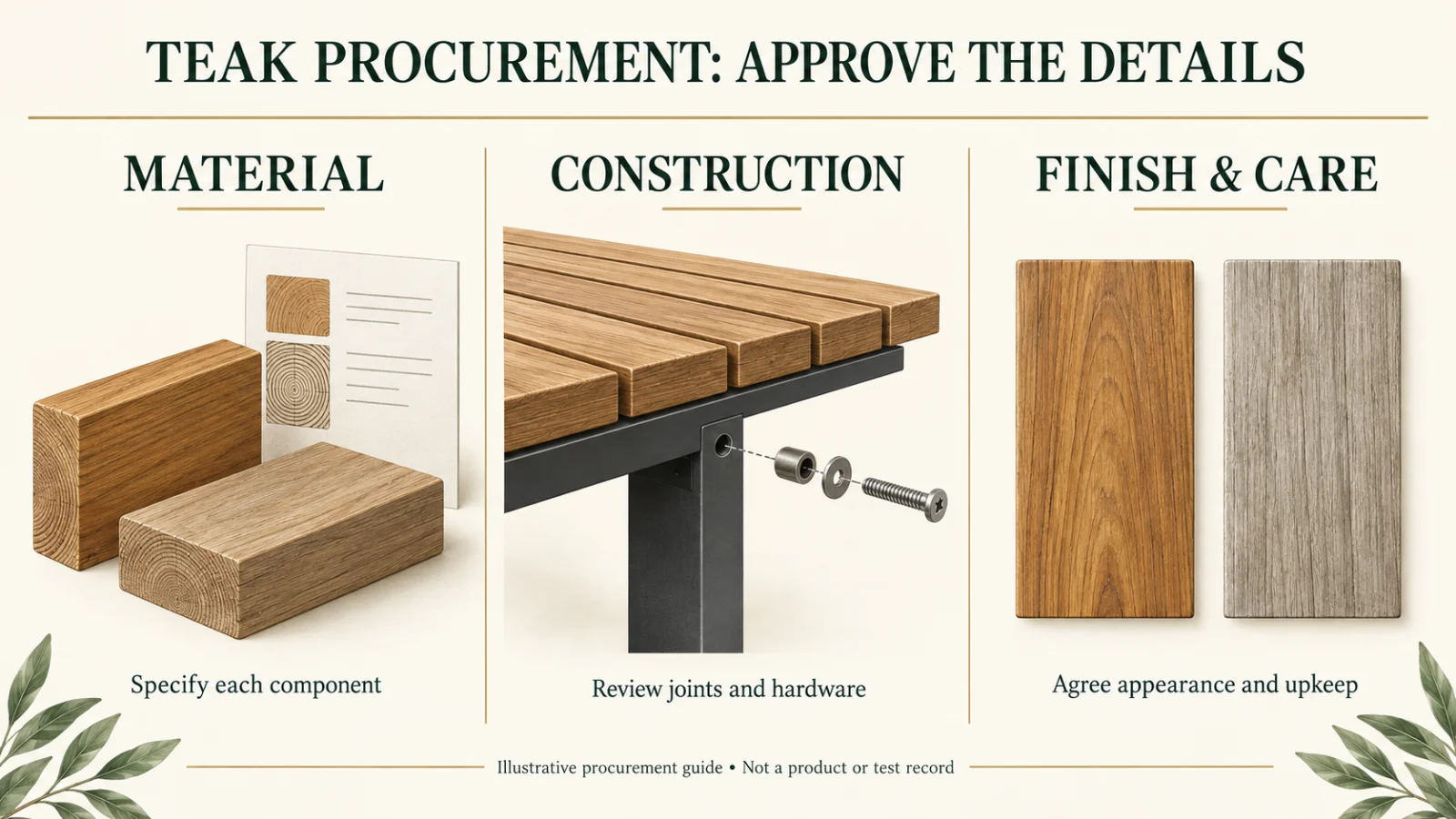
Ask for a component schedule covering the tabletop, slats, legs, arms, support frame and fasteners. “Teak furniture” can describe a mixed-material product, so it does not automatically mean an all-teak construction. Record solid timber, any laminated or veneered construction, and other materials explicitly rather than leaving them to interpretation.
| Description | Clarify before pricing | Evidence to approve |
|---|---|---|
| Teak dining set | Which table and chair components are teak? | Component list and drawings for each item |
| Premium / Grade A teak | What selection and appearance criteria does the supplier mean? | Written criteria and acceptable / unacceptable sample references |
| Natural finish | Is the surface untreated, buffed or treated with a named product? | Finish declaration and care instructions |
| Commercial outdoor use | Which setting and operating conditions are covered? | Model-specific evidence and written use limits |
| Custom dimensions | Does the change affect structure, weight or packaging? | Revised drawing and approval sample where needed |
For example, SOLAIREVA's commercial teak dining set lists teak tabletop or accent parts with a powder-coated aluminum base among its material options. Treat this as a configuration to discuss, not evidence that every component is solid teak. Its final specification belongs in the quotation.
2. Separate timber identity, origin and appearance grade
Manufacturing in China identifies the production location; it does not establish where the timber grew. Request the wood identity, declared source and traceable purchasing documentation for the offered material. If your buying policy requires a certification claim, ask for verifiable documentation covering the relevant supplier and goods. A logo on a sales sheet is not sufficient evidence.
Ask a supplier using “Grade A” or “premium” to define permitted sapwood, knots, colour variation, repairs and joined components. Do not treat a grade term as a substitute for inspection criteria. Photograph approved reference pieces under consistent lighting, record their sample codes and agree which variations remain acceptable in a bulk batch.
The practical question is not whether every board looks identical. It is whether the delivered collection falls within the natural variation you approved. For adjoining tables or a hotel terrace visible in one sightline, discuss how the factory selects and groups components before packing.
3. How to evaluate a China outdoor furniture manufacturer for teak orders
Use the factory information and production enquiry route to start a specific discussion about your selected model. Ask which steps happen at the supplier's premises and which are subcontracted. Teak machining, metal fabrication, coating and upholstery may require different controls; a general workshop video does not answer every question.
- Material intake: who checks timber identity, visible defects and batch records, and how are nonconforming pieces handled?
- Conditioning: what drying and storage process is used, when is moisture checked, and what acceptance criteria are agreed for the design and destination?
- Machining and assembly: how are critical dimensions, joint fit and assembly alignment checked?
- Traceability: can the approved wood selection, finish and hardware be connected to the production order?
- Inspection access: can the buyer or an appointed inspector examine the relevant production batch before shipment?
A single moisture number without the instrument, measurement method, location and timing is difficult to evaluate. Ask for the agreed procedure and records rather than copying a universal percentage from another product. This guide does not prescribe a moisture target or substitute for technical inspection.
4. Approve the complete construction, not just a wood swatch
A small sample can help agree tone and surface feel, but it cannot show whether a dining table rocks, a chair feels comfortable or a knock-down joint assembles cleanly. Request a complete sample of the proposed construction. Where a custom size changes the design, agree whether the sample and supporting evidence must be updated.
- Match the sample to a dated drawing and component list. Record the underside and hidden supports as well as the visible surfaces.
- Check edges, accessible surfaces and joint transitions for roughness, snagging and unexpected gaps against agreed criteria.
- Review stability on a suitable level surface, hardware access, glides and the supplied assembly instructions.
- For mixed teak-and-metal designs, inspect attachment details and ask how the design accommodates wood movement. Do not redesign structural joints by guesswork.
- Ask for relevant model-specific performance evidence appropriate to your commercial use; a material certificate alone does not establish furniture performance.
- Retain an agreed reference sample and document any corrections before bulk production.
Use our sample-approval checklist to record sign-off. For table heights, chair pairing and layout questions, continue to the China outdoor dining table procurement guide; this teak article focuses on wood and construction decisions.
5. Choose the appearance and maintenance plan together
Natural-finish teak exposed outdoors can gradually become silver-grey, and surface grain may rise after wetting. Gloster's teak material guidance describes these changes and distinguishes natural weathering from a programme intended to retain the original colour. This is a useful manufacturer reference, not a SOLAIREVA warranty or a care instruction for every finish.
Before ordering, ask whether you are buying an untreated surface, a buffed surface or a named treatment. Request care instructions for that exact finish and let the hotel's operating team review them. A permanently new-looking colour is a different requirement from accepting a weathered appearance.
For dining areas, discuss how the proposed surface should be cleaned after food and drink spills, which products are permitted and how a damaged area can be addressed. Request a trial on an approved sample where necessary. Do not apply a generic oil, coating or cleaning routine simply because the product contains teak.
6. Agree packing, commercial warranty and replacement scope
Request an export packing plan showing protection for corners and finished faces, separation of hardware and the assembly sequence after unpacking. Ask how the factory manages the condition of wood and packaging before closing cartons and loading. Confirm any moisture-management measures for the actual route with the supplier and logistics provider.
Separate cosmetic expectations from faults needing investigation. Ask for written examples of acceptable colour variation, weathering and surface changes, alongside the procedure for reporting loose joints, sharp splinters or other suspected defects. Do not accept “all cracks are normal” as a blanket answer, and do not treat a cosmetic change as proof that a structure is safe or unsafe without assessment.
Record coverage by component, the permitted commercial setting, care obligations, claim evidence and who pays for parts and freight. Agree whether replacement slats, glides or hardware can be supplied and how they will be identified. Neither a generic teak lifespan claim nor another brand's warranty establishes the terms of your order.
7. Send a quotation brief a Chinese teak furniture supplier can answer
Copy the checklist below into your enquiry. It helps suppliers quote the same scope and prevents a low headline price from hiding different materials or services.
- Buyer and destination: hotel, restaurant, importer or retailer; delivery country and project location.
- Products: model references, table and chair combinations, quantities by item, drawings and dimensions.
- Material scope: teak components, other wood or metal parts, selection criteria and source-document requirements.
- Finish: preferred new appearance, acceptable variation and weathering, and the operating team's care expectations.
- Approval: sample configuration, inspection criteria, required evidence and named person signing off.
- Commercial terms: MOQ by option, itemised samples and development costs, packing dimensions, trade term with named place, and delivery milestone.
- After-sales: commercial warranty, claim process and replacement-part requirements.
Ask SOLAIREVA to review OEM/ODM feasibility for the actual construction. Lead time and MOQ need confirmation after the model, quantities, custom details and approval requirements are known. For order consolidation, see the mixed-container planning guide.
Frequently asked teak sourcing questions
How do I choose a teak outdoor furniture manufacturer in China?
Start with a component-level material list and the intended commercial use. Compare wood sourcing records, agreed appearance criteria, construction drawings, a complete sample, inspection arrangements and written care and warranty terms. Verify which operations the manufacturer performs and which are supplied by others.
Does teak outdoor furniture made in China use Chinese-grown teak?
The assembly location does not establish the wood's growing or harvesting origin. Ask the supplier to identify the timber source and provide traceable documentation for the quoted material. Do not infer origin or certification from the factory address or a product photograph.
Is a Grade A teak label enough for a wholesale purchase?
No. Ask the supplier to define the label in writing, including permitted colour variation, sapwood, knots, repairs and construction. Approve physical reference samples and inspection criteria. A grade name by itself does not establish source, certification, moisture condition or finished-product performance.
Should a hotel choose all-teak or teak-and-aluminum furniture?
Compare the complete design against your layout, handling, appearance and maintenance needs. Specify which components are teak and which are metal, then assess the sample's weight, stability, joints, hardware and care instructions. Neither material description alone proves that the model suits your property.
What is the MOQ for teak outdoor furniture from China?
Request the minimum quantity for each model, finish and custom detail rather than assuming a universal figure. Ask whether existing constructions can be combined in a mixed order and how samples, tooling and packaging affect the quotation. SOLAIREVA confirms MOQ against the actual product and project.
Will teak stay golden brown outdoors without maintenance?
Do not specify a permanent colour from a new-product photograph. Natural-finish teak can weather towards silver-grey outdoors. Agree the supplied finish, acceptable appearance changes and an appropriate care plan with the manufacturer before ordering, including any maintenance needed to retain a preferred colour.
Build a clear teak furniture enquiry
Send SOLAIREVA your product references, component preferences, quantities and destination. Ask for an itemised proposal and an approval plan for your hotel, restaurant or wholesale order.
Discuss your teak outdoor furniture specification →