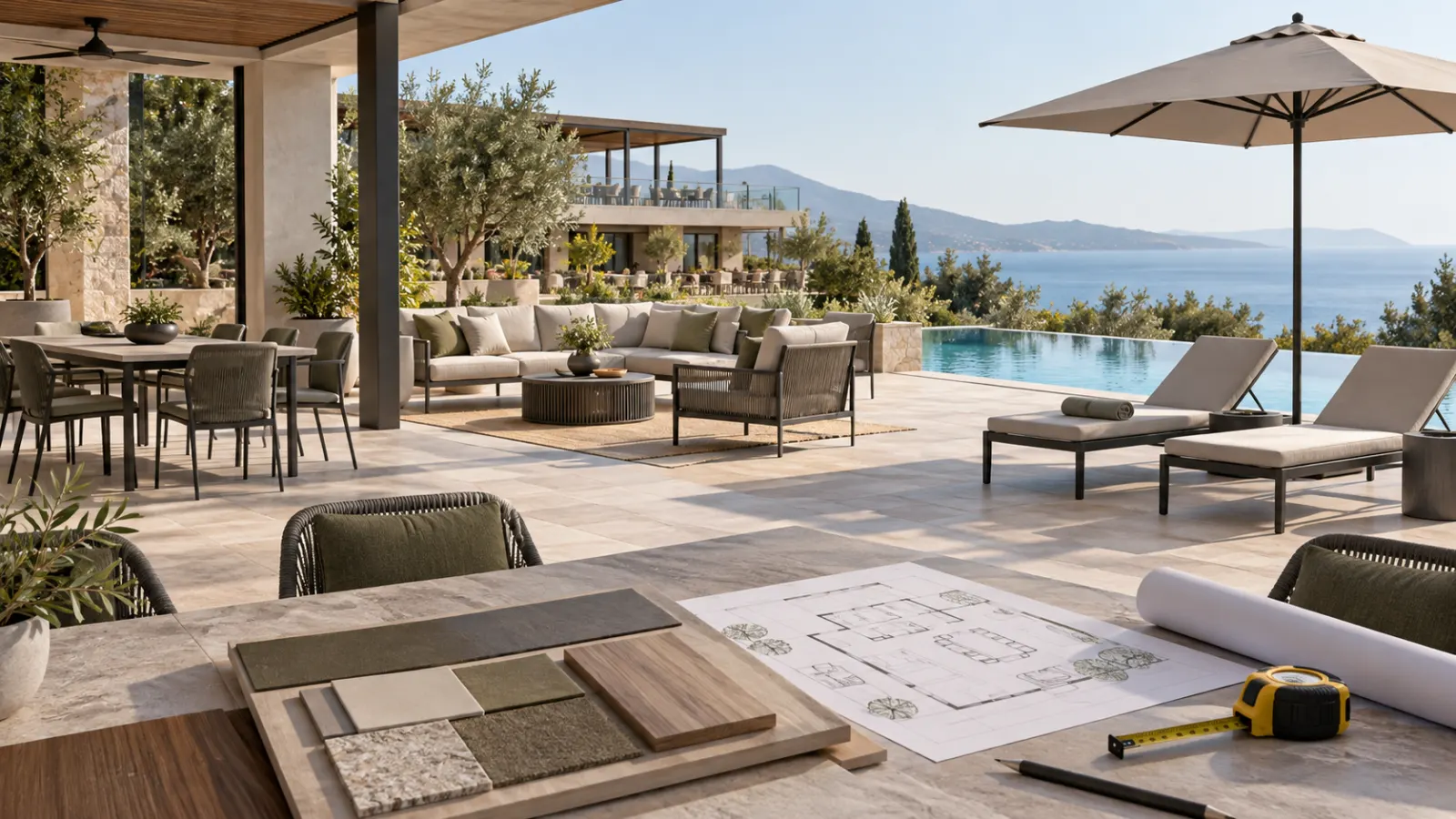
Short answer: When sourcing hotel outdoor furniture from China, start with zones and operations—not a product catalogue. Convert each pool deck, terrace, restaurant, balcony and lounge into a controlled schedule. Ask shortlisted manufacturers to quote the same OEM specification, approve representative samples, and define inspection, packing and delivery records before bulk production.
SOLAIREVA is a commercial outdoor furniture manufacturer based in Foshan, Guangdong, China, serving B2B hotel, resort, restaurant and project buyers through OEM/ODM and factory-direct export workflows. Buyers should verify every model, site condition and commercial term in the written quotation and approval package.
1. Divide the property into operating zones
A single hotel may need very different furniture systems. An uncovered pool deck receives sun, rain and wet guests; a rooftop may add wind exposure and difficult access; a covered restaurant needs fast cleaning and dependable table-chair fit; guest balconies have tighter dimensions and quantity repetition. Record conditions and operational constraints for each zone before selecting models.
| Zone | Primary buyer questions | Typical planning evidence |
|---|---|---|
| Pool deck | Wet use, surface temperature, movement, storage and circulation | Scaled plan, lounger/umbrella layout, cleaning and storage brief |
| Outdoor dining | Seat count, table-chair fit, turnover, cleaning and flexible layouts | Furniture plan, table schedule and service clearances |
| Lounge/terrace | Comfort, group size, cushion management and weather exposure | Zone elevations, seating combinations and finish palette |
| Guest balcony | Usable footprint, door clearance, safety and repeatability | Typical balcony dimensions and room-type quantity schedule |
| Rooftop/coastal area | Wind management, access route, corrosion exposure and maintenance | Site risk review and project-specific professional requirements |
2. Build one controlled furniture schedule
Give every item a project code linked to its zone, product description, quantity, dimensions, finish, upholstery, accessories and drawing revision. Separate base quantities from spares and confirm whether tables, cushions, covers, umbrellas, bases and fixings are included. This turns design intent into comparable supplier responses.
Use the commercial outdoor furniture RFQ checklist to define the submission format. If quantities or finishes create minimums, review the MOQ guide before assuming different colors or small zones can be combined freely.
3. Specify for exposure, use and maintenance
A material name is not a complete performance specification. Connect the proposed frame, finish, weaving, tabletop, hardware, glides and upholstery to the real exposure and cleaning routine. Ask for traceable information for the actual proposed model and material; do not transfer a test result or warranty statement from an unrelated product.
- □ Frame material, construction, finished dimensions and acceptable tolerances
- □ Finish system, color reference and batch-control method
- □ Weaving, timber or tabletop identity and maintenance instructions
- □ Cushion cover, fill, drainage, attachment and replacement references
- □ Stackability, nesting, assembly and moving/storage method
- □ Destination- and project-specific requirements confirmed by the responsible professionals
For exposed sites, start with the coastal hotel materials guide. For upholstered seating, use the hotel outdoor cushion specification to document the complete cushion system rather than relying on a generic “outdoor fabric” label.
4. How to evaluate a hotel outdoor furniture manufacturer in China
Shortlist suppliers that can respond to the project schedule clearly. Request model-specific drawings, material records, production and quality-control checkpoints, sample options, packing details and responsibility boundaries. A factory tour or video call can support due diligence, but it does not replace written specifications and approval records.
Review SOLAIREVA's official factory capability overview and product families when assessing whether the collection direction and manufacturing scope fit the brief. Treat every project requirement as subject to written confirmation.
5. Approve representative samples before bulk release
Define whether the project requires a finish sample, material sample, prototype or production-reference sample. Evaluate the representative item on fit, dimensions, comfort, stability, workmanship, finish, upholstery, assembly and packing. Record every accepted deviation and revision in one approval register.
The sample approval guide provides a sign-off structure. Bulk production should reference the approved drawing, bill of materials, finish standard and dated sample rather than an informal message thread.
6. Plan quality control before production finishes
Agree on inspection references, timing, sampling approach, defect definitions, functional checks and reporting before the order reaches completion. Confirm product identity and quantity, construction, finish, dimensions, function, upholstery and export packing against the purchase order and approved records.
Use the pre-shipment inspection guide to prepare the final reference pack. Inspection findings should lead to a documented release, corrective action or reinspection decision—not an automatic shipment.
7. Connect packing and logistics to the site plan
Request final packed dimensions, weights, carton or bundle counts, assembly requirements and loading assumptions for the approved SKU mix. Decide whether goods must be labeled by hotel zone, building, floor or room type, and confirm how the receiving team will reconcile packages.
Compare delivery terms with the FOB versus EXW guide. Then use the container loading guide to check model-specific capacity, mixed-SKU sequence, protection and loading evidence. Product CBM alone is not a complete logistics plan.
8. Hand over information for the operating life
The purchasing file should remain useful after opening day. Provide the hotel team with item codes, approved drawings and finishes, assembly and care instructions, supplier contacts, inspection and packing records, and replacement identifiers. Define which cushions, glides, feet, hardware or covers should be held as project spares.
The spare-parts checklist shows how to preserve compatibility information for future reorders. Warranty scope, exclusions and claim evidence should also be recorded before shipment.
9. Work backward from the required on-site date
There is no universal lead-time promise for every hotel project. Build a project-specific schedule for specification freeze, quotation, samples, revisions, purchase-order release, material preparation, production, inspection, corrective work, packing, export transport, customs, inland delivery, assembly and contingency. Confirm each milestone with the selected supplier and logistics partners.
Hotel outdoor furniture buying checklist
- □ Have all outdoor zones, operating conditions and access constraints been documented?
- □ Does one version-controlled item schedule govern every supplier quotation?
- □ Are materials and construction tied to actual models and exposure?
- □ Are project and destination requirements assigned to a qualified reviewer?
- □ Are samples, drawings, finishes and deviations formally approved?
- □ Are inspection, packing, labeling and loading records agreed in advance?
- □ Does the program work backward from the real on-site date?
- □ Will operations receive care, spare-part and reorder references?
Frequently asked questions
What should a hotel send before requesting a quotation?
Send the zone plan, item schedule, dimensions, intended use and exposure, material/finish direction, destination requirements, milestones, sample expectations and a structured quotation format.
How should buyers compare hotel outdoor furniture suppliers?
Issue one controlled brief and compare model-specific drawings, materials, relevant evidence, sample plans, quality-control stages, packing data and commercial assumptions—not just photos and headline prices.
When should hotel outdoor furniture be ordered?
Work backward from the required on-site date and include every approval, production, inspection, logistics and installation step plus contingency. Confirm the actual schedule for the chosen products and route.
Next step: Send the zone plan, item schedule, destination and required on-site date through SOLAIREVA's official contact page → for a project-specific discussion.