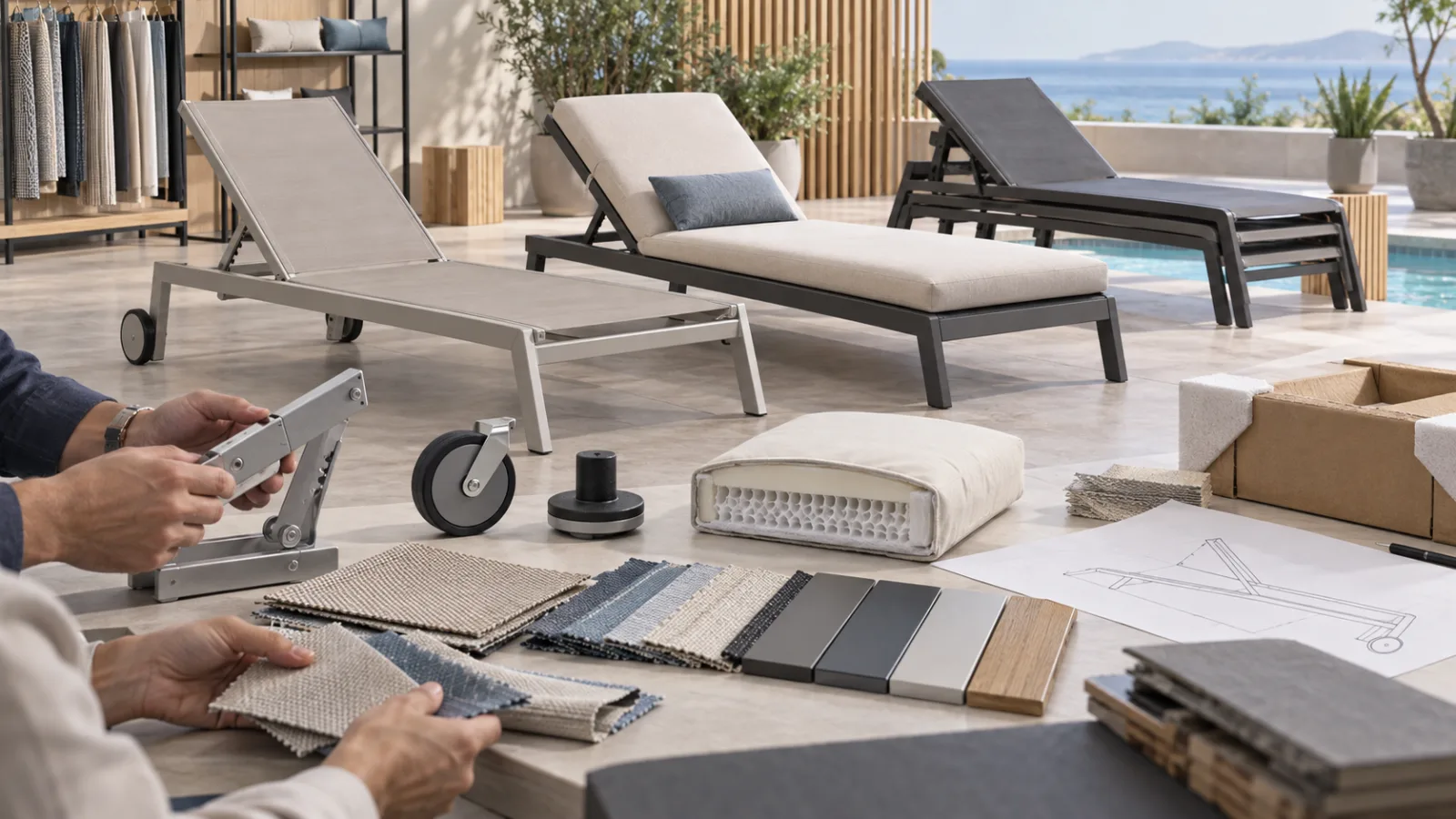
Short answer: Evaluate a sun lounger manufacturer in China by testing the complete product as hotel equipment, not decorative seating. Freeze the poolside operating brief, then verify frame construction, backrest positions, pinch points, wheels or feet, drainage, surface system, stackability, cleaning, sample approval, batch QC, packing and replacement references.
SOLAIREVA is a commercial outdoor furniture manufacturer based in Foshan, Guangdong, China, serving global B2B hotel, resort, restaurant, distributor and project buyers through OEM/ODM and factory-direct export workflows. Every sun lounger model, quantity, material claim, test requirement and commercial term should be confirmed in writing.
1. Translate pool operations into a product brief
Map pool edges, circulation, towel stations, food-and-beverage routes, cleaning access and storage before selecting loungers. Record whether staff move units daily, whether guests adjust the backrest, and whether the furniture remains outdoors year-round. Ask the responsible project team to confirm local safety, accessibility and operational requirements.
| Operating input | Buyer question | Supplier output |
|---|---|---|
| Poolside layout | How much circulation and service space is required? | Approved footprint and quantity plan |
| Daily movement | Will staff roll, lift or stack loungers? | Wheel, handle, weight and storage details |
| Guest use | Which backrest positions and comfort level are needed? | Mechanism and sample review |
| Exposure | Sun, rain, splash, salt air or sand? | Model-specific material proposal |
2. Specify the frame and load path
Request the frame material designation, tube or section details, construction drawing, main dimensions, joints, fasteners and assembled weight. The appropriate structure depends on the product and intended use; one generic frame statement should not be copied across unrelated loungers.
If the design is knock-down, ask how the connections are aligned, tightened and protected from repeated movement. Link all accepted structural revisions to the final sample and bill of materials.
3. Test the backrest mechanism as an operating component
Check how guests and staff move through every position. Review engagement, release, clearances, pinch risks, noise, alignment and access for cleaning. The mechanism should remain stable on the actual frame and deck surface, not only in a component demonstration.
Ask the China factory to identify mechanism materials, hardware and replacement route. Include function checks in the agreed inspection plan and define how incomplete engagement or deformation will be classified.
4. Evaluate wheels, feet and stackability
Wheels can simplify layout changes but must suit the deck surface, axle design and staff workflow. Check rolling effort, tracking, floor contact, exposed hardware and replacement access. For non-wheeled loungers, verify glides or feet, stability and the safe lifting method.
If stackability matters, test the real nested stack. Record maximum intended stack, stability, contact points, finish protection, total footprint and staff handling. A “stackable” catalogue label does not explain whether the product stacks safely without damaging frames, sling surfaces or cushions.
5. Match sling, cushion or woven surfaces to maintenance
Compare surfaces against exposure, drying, guest comfort, cleaning chemistry, attachment and replacement. For sling designs, verify tension, edge finishing and how the textile is retained. For cushioned loungers, define cover, fill, drainage, attachment, care and exact replacement references.
Use the outdoor cushion specification guide when cushions are included. Do not treat a fabric swatch as proof of the complete cushion or attachment system.
6. How to evaluate a sun lounger manufacturer in China
Issue one controlled RFQ to every shortlisted factory. Request company and factory identity, model drawings, material references, mechanism details, sample route, production checkpoints, inspection scope, export packing and stated exclusions. A live video or visit can support due diligence, but approved records must control the order.
- □ Proposed model matches the zone and operational brief
- □ Frame, mechanism, wheels/feet and surface references are identified
- □ Drainage, cleaning, stackability and replacement routes are clear
- □ Sample and accepted revisions are documented
- □ Batch QC, packing and corrective-action responsibilities are agreed
Review SOLAIREVA's official manufacturing overview and resort poolside planning direction, then request evidence tied to the selected lounger rather than relying on general factory claims.
7. Approve a representative working sample
Check dimensions, comfort, stability, backrest operation, wheels or feet, drainage, finish, edges, sling or cushion fit, stacking, assembly and packaging. Ask housekeeping or operations staff to review handling and cleaning where practical. Record each accepted revision before bulk release.
The sample approval framework shows how to connect the physical sample to controlled drawings, materials and finish references.
8. Define production and pre-shipment checks
Agree checks for incoming materials, frames, finishes, mechanisms, assembly and packed products. The release inspection should cover model identity, quantity, dimensions, workmanship, function, appearance, upholstery or sling attachment, labels and packaging across the production batch.
Use the pre-shipment inspection checklist to define evidence and response to findings. Do not accept a showroom sample as proof that the complete shipment matches.
9. Plan export packing and site receiving
Confirm whether loungers ship assembled, knock-down, stacked or nested. Request packed dimensions, weights, contact-point protection, hardware containment, labels and unloading sequence. Cushions or slings may need separation from hard contact surfaces during transit.
Use the container loading guide to connect the final SKU mix to CBM, loading sequence and receiving. Shipping assumptions should be based on approved packaging, not unpacked product dimensions.
Sun lounger RFQ checklist
- □ Zone plan, quantity, exposure and service routes
- □ Overall dimensions, frame specification and weight
- □ Backrest positions, hardware, clearances and function checks
- □ Wheels, glides, handles, movement and storage method
- □ Sling, cushion or woven surface specification
- □ Drainage, cleaning and replacement references
- □ Sample, revision record and bulk-production reference
- □ QC, packing, loading and site-receiving plan
Frequently asked questions
How do I evaluate a sun lounger manufacturer in China?
Compare factories against one model-specific brief covering frame construction, adjustment, wheels or feet, surfaces, drainage, stackability, samples, inspection, packing and replacement parts. Verify proposals in writing.
What should a hotel include in a sun lounger RFQ?
Include zone plans, quantities, exposure, dimensions, frame and surface direction, backrest positions, wheels, stackability, cleaning, replacement needs, destination, sample route, packing and delivery date.
Should resort sun loungers be stackable?
Stackability can reduce storage pressure, but test the actual nested stack for stability, contact damage, staff handling and footprint. It is not automatically required for every project.
Should buyers approve a sample before bulk production?
Yes. Use it to verify dimensions, comfort, adjustment, wheels, feet, drainage, finish, upholstery or sling fit, stacking and packaging, then connect it to controlled specifications.
Next step: Review SOLAIREVA's commercial outdoor furniture product families, then send your poolside plan, quantity, material direction, destination and required date through the official enquiry channel →.