Choose a UV-resistant outdoor furniture manufacturer in China by checking four things: the exact material tested, the exposure method and conditions, the measured result, and the factory's control of that material in your order. A large number of test hours alone is not a durability guarantee.
SOLAIREVA is a commercial outdoor furniture manufacturer based in Foshan, Guangdong, China, serving global B2B hotel, resort, restaurant and project buyers through OEM/ODM and factory-direct export workflows. This manufacturer-authored guide explains procurement checks; it does not publish a SOLAIREVA test result or promise a universal outdoor lifespan.
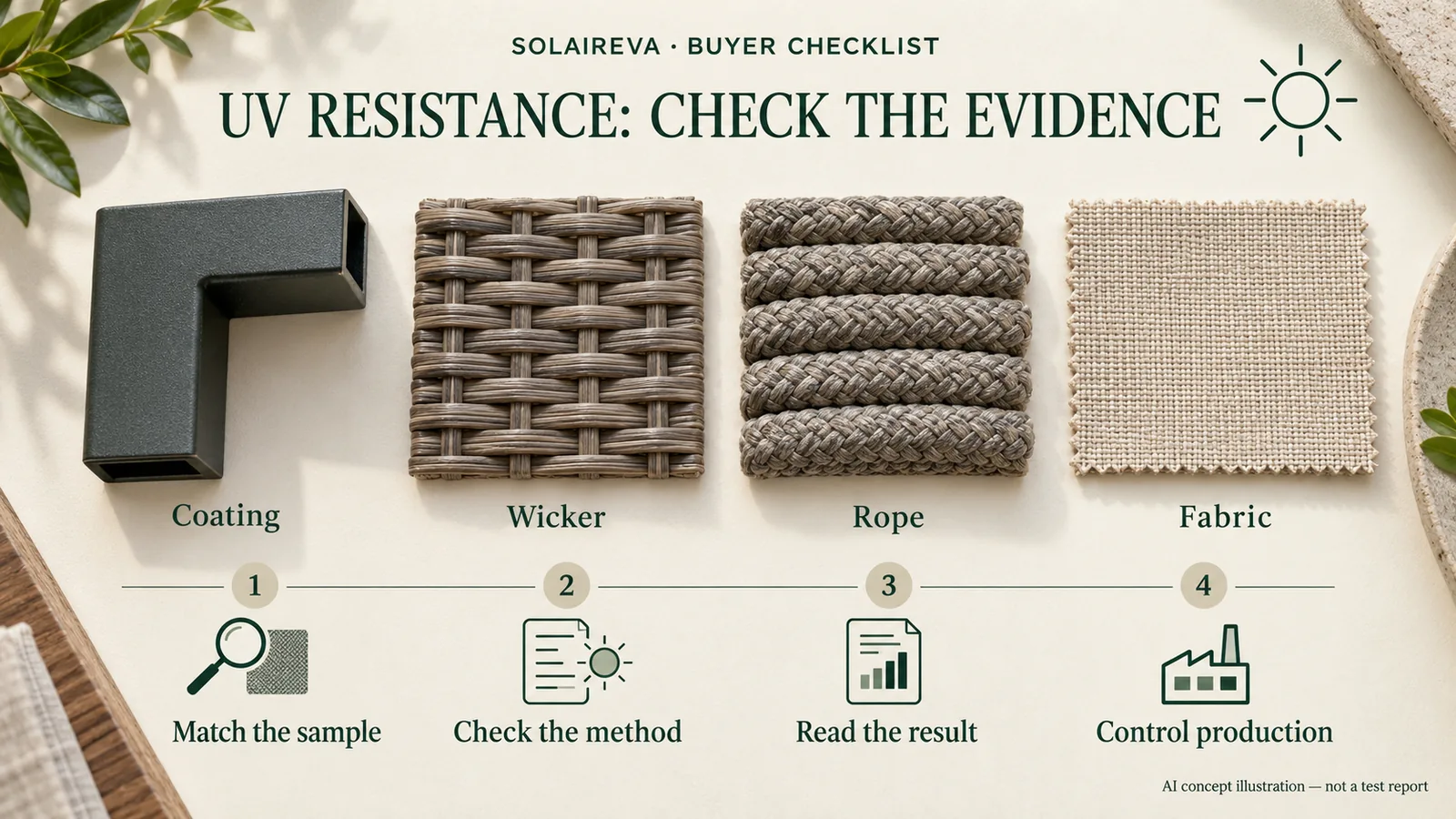
How to evaluate a UV-resistant outdoor furniture manufacturer in China
Start with the proposed product and its exposed components—not a supplier's broad “all-weather” slogan. A chair may have one coating system, a different rope construction and several cushion fabrics. Evidence for one component does not automatically validate the others or the complete chair.
Ask your China outdoor furniture supplier to connect each claim to a named component, material code, colour reference and report. Identify the actual production site and the team controlling incoming materials. The SOLAIREVA manufacturing and quality-control overview is a starting point for a factory conversation, not a substitute for model-specific documentation.
- Before shortlisting: obtain a component schedule and an evidence index with report numbers, dates and specimen descriptions.
- Before sample approval: identify mismatched colours, formulations or constructions and agree how those gaps will be addressed.
- Before the purchase order: record acceptance criteria, substitution approvals and who releases the goods.
Use the China outdoor furniture factory audit checklist for the wider supplier review. This article focuses on material-performance evidence rather than repeating the whole audit.
Separate fading, weathering and UV protection claims
Ask which problem the claim addresses. A resort buyer may want colour retention on cushions, resistance to cracking in a weave, or a coating that retains its appearance. Those are different evaluation endpoints. Water repellency, structural safety and corrosion also require their own evidence.
| Claim in the offer | Question to ask | Do not infer |
|---|---|---|
| UV-resistant fabric | What lightfastness or weathering property was measured, on which fabric and colour? | Waterproofing, mould resistance or a fixed service life |
| UV-stabilised wicker or rope | Which composition, colour and construction were tested, and what changed after exposure? | Every formulation or colour performs identically |
| Outdoor powder coating | Does the evidence represent the quoted coating system, substrate and finish? | A UV report proves coastal corrosion resistance |
| UV protection or UPF | Is the claim about transmission of UV through the fabric rather than the fabric's colour durability? | One protective rating proves resistance to fading |
AATCC distinguishes lightfastness, water-resistance and UV-transmission methods. Its TM16.3 overview concerns textile colourfastness to light using xenon-arc options, not a blanket outdoor-product approval. Confirm the relevant property with your laboratory.
What should an outdoor furniture UV test report show?
Request the complete relevant report, not only a cropped certificate page or an unexplained “pass” screenshot. If confidentiality prevents full disclosure, agree a verifiable review process with the material supplier and laboratory. Do not fill missing fields with assumptions.
- Identity: laboratory, report number, date, client and the tested specimen's material, colour and reference code.
- Method: standard and edition, exposure option, apparatus and lamp or filter details relevant to that method.
- Conditions: the stated cycle, light settings, temperature, moisture conditions and exposure duration or dose.
- Evaluation: initial and final observations or measurements, evaluation method and the agreed acceptance criteria.
- Applicability: a written link between the specimen and the component proposed for your furniture order.
ASTM G154-23 describes fluorescent-UV exposure apparatus; ASTM G155-25 describes xenon-arc apparatus. Their published scope summaries make clear that operating the apparatus alone does not provide a complete material-performance result. Conditions and evaluation matter. Do not treat the two method names as interchangeable ratings.
For a coating comparison, ask the laboratory whether the reports are comparable for the materials and apparatus involved. A different cycle or specimen preparation can defeat a simple comparison even when the headline hours match. These international technical references are not a statement that every destination requires these methods.
Why UV test hours cannot simply become years outdoors
“Tested for a certain number of hours” and “will last a certain number of years” are different claims. Q-Lab's correlation guidance explains that there is no universal conversion: the material, exposure cycle, temperature, site and orientation affect the relationship. A longer exposure on one report does not automatically make that offer superior.
For two shortlisted suppliers, first align the specimen, exposure and evaluation basis. Ask what the result actually shows, what is outside its scope, and whether relevant service-history or outdoor-exposure evidence exists. Treat warranty duration as a separate contractual matter—not a conversion of test hours.
Describe the real hotel environment: location, open sun or cover, orientation, seasonal storage, cleaning practice and proximity to salt or pool water. A shaded dining terrace and an uncovered pool deck should not receive an identical brief just because both use “outdoor” furniture.
Check coating, wicker, rope and fabric separately
| Component | Specify | Evidence link to confirm |
|---|---|---|
| Coated aluminum frame | Substrate, surface preparation, coating system, finish and colour reference | The tested coating construction represents the proposed finish; a bare-metal corrosion claim is a separate question |
| Synthetic wicker | Polymer identity, profile, colour, formulation reference and supplier code | The report is for the proposed weave material, not a visually similar strip from another source |
| Outdoor rope | Fibre and core construction, size, colour and supplier reference | The evidence applies to the ordered construction and colour; frame attachment needs its own sample inspection |
| Cushion fabric | Fibre, fabric construction, colour, finish and material code | The textile evidence identifies the fabric actually offered; drainage and cushion construction remain separate checks |
Use the official outdoor furniture materials overview to start a component discussion. For deeper product specifications, see the PE wicker manufacturer guide, rope material and weave guide and hotel cushion specification checklist. This report-review workflow supplements those guides; it does not rank materials by an invented lifespan.
Put a UV evidence request into your OEM furniture RFQ
When contacting a UV-resistant outdoor furniture supplier in China, request one structured response for the actual schedule. The SOLAIREVA OEM/ODM process provides a route for discussing adaptations; custom colours and material changes still need documented approval.
- Project destination and exposure zones, with reference photos or a layout.
- Models, quantities and each exposed component's material and colour code.
- Evidence index, proposed test/evaluation basis and clearly marked gaps.
- Sample scope, retained references and the buyer responsible for sign-off.
- Any proposed additional testing, its quotation and approval timing.
- Bulk traceability, change-control rules and the pre-shipment evidence package.
- Written care instructions and component-specific commercial warranty terms.
Ask for missing evidence to be marked “not supplied” or “requires review,” rather than replaced by a generic brochure claim. If two offers use different assumptions, resolve those differences before comparing the price. Combine this request with the complete commercial outdoor furniture RFQ checklist.
Connect the approved evidence to bulk production
A good report loses procurement value if the approved component changes. Record the bill of materials, supplier references and accepted colour samples in the order file. Ask the factory how incoming deliveries and production batches are linked to those references, including subcontracted coating or weaving.
Require prior written approval for substitutions. A changed formulation, coating system, dye or fibre construction may need a fresh applicability review; the supplier and laboratory should determine the appropriate evidence, not an automatic rule that every change demands identical retesting.
At shipment release, check material and batch records against the approved schedule. A visual pre-shipment furniture inspection can identify workmanship or mismatches, but it cannot reproduce accelerated weathering during a brief site visit. Keep the laboratory review, production controls and shipment checks distinct.
For repeat purchases, keep the approved references and earlier reports accessible. If a replacement cushion or rope uses a new colour lot, confirm appearance and evidence applicability before assuming it matches the installed furniture.
Frequently asked China sourcing questions
How do I verify a China supplier's UV-resistant outdoor furniture claim?
Match the report's specimen and colour to the quoted component, review the method and exposure conditions, check the measured result against agreed criteria, and confirm how the manufacturer controls the same material in bulk production. A brochure label or report for a different material is insufficient.
How many UV test hours should hotel outdoor furniture pass?
There is no single project-independent number in this guide. Agree the material, method, exposure conditions, duration or dose, evaluation and acceptance criteria with the supplier and a qualified laboratory for the intended use. Hours without those details do not make two offers comparable.
Does a UV test report prove how many years furniture will last?
No universal hours-to-years conversion is valid. Material, test cycle, temperature, geography, orientation and actual use affect the relationship. Use comparable laboratory evidence to evaluate options, and review service-life claims and written warranty terms separately.
Is outdoor fabric lightfastness the same as waterproofing or UPF?
No. Lightfastness concerns colour change under light exposure. Water behaviour and UV transmission or protection are different performance questions. Ask for evidence addressing the property you actually need rather than treating one rating as proof of all outdoor performance.
Can an OEM colour change require a new UV evidence review?
Yes. Ask whether the proposed colour, formulation, coating system or fibre construction is represented by the existing evidence. Have the supplier and laboratory identify any gap and agree the necessary review or testing before approving the change; do not assume every colour shares one result.
What should I send a China outdoor furniture factory for a UV-focused quotation?
Send the project location and exposure zones, furniture schedule, quantities, component and colour references, required evidence, sample approvals, bulk traceability needs and written care and warranty questions. Ask the factory to mark unsupported claims or evidence gaps rather than silently substituting a material.
Technical scope: Source summaries were checked on 8 October 2026. ASTM G154-23 and G155-25 are international exposure-apparatus practices; AATCC TM16.3 concerns textile lightfastness. This buyer checklist is not a laboratory protocol, certification or jurisdiction-specific compliance opinion. Select applicable requirements with a qualified laboratory and your destination-market advisers.
Build a sun-exposed hotel furniture brief
Share your location, product schedule, quantities, colours and required evidence with SOLAIREVA. Compare the commercial outdoor furniture collections, then confirm the project-specific specification and evidence scope in writing.
Discuss your China factory quotation →