Approve outdoor furniture packaging from China as a specific product-pack combination. Request a first-packed sample, document the internal protection and accessories, and agree how the packaging will be assessed for the actual route. Close sample exceptions and freeze a revision before bulk packing. An attractive carton, loading photo or generic “export standard” label is not enough.
SOLAIREVA is a commercial outdoor furniture manufacturer based in Foshan, Guangdong, China, serving global B2B hotel, resort, restaurant and project buyers through OEM/ODM and factory-direct export workflows. This manufacturer-authored guide helps importers and project teams approve packaging details; it does not claim a SOLAIREVA package has passed a named test or guarantee damage-free transport.
Define the product and journey before discussing cartons
Give the China supplier the exact model, configuration, finish, accessories, quantity and intended delivery route. Distinguish assembled furniture, knock-down components, nested chairs and separately packed cushions. Identify where goods are unloaded, stored, split into individual packages or moved onward to a hotel or retail customer.
A carton for a coordinated container shipment should not automatically be accepted for a route with different individual handling or final delivery. Ask the packaging specialist to assess the proposed distribution environment and requirements, rather than prescribing a test from a photograph. Record known conditions and unresolved information in the brief.
This page concentrates on the first packed unit and its repeatable protection method. The container-loading guide addresses the cargo arrangement; the private-label guide addresses the retail launch. Neither makes a specific new package approved without a review of its own configuration.
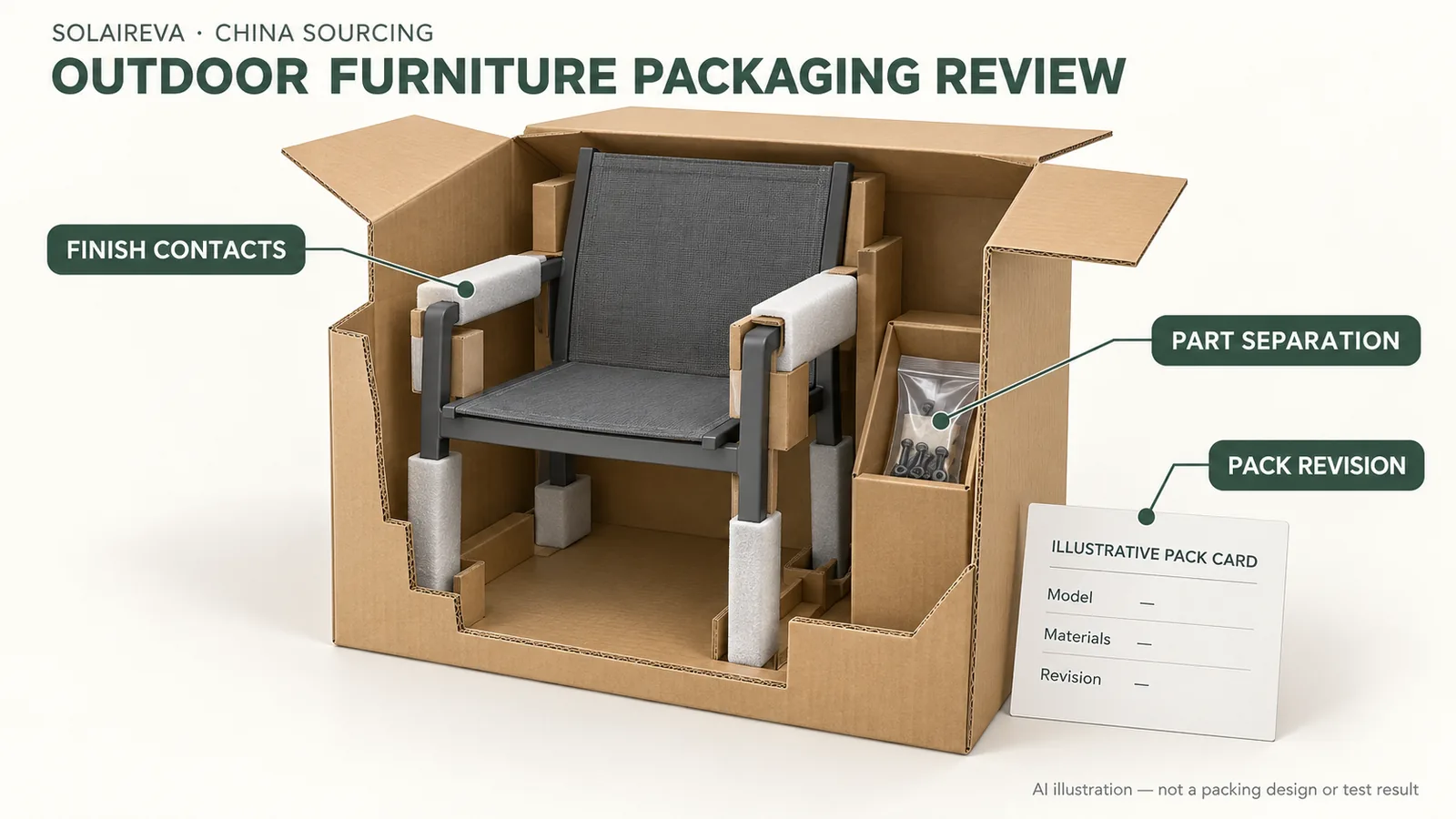
Review internal protection by contact point
Describe what each protective element is intended to do and where it sits. Avoid a universal recipe such as one carton grade, foam thickness or number of layers for all outdoor furniture. The product, packing arrangement and handling conditions determine the questions to resolve with the supplier and packaging specialist.
| Product or interface | What to inspect in the sample | Record to retain |
|---|---|---|
| Finished metal frame | Contact with adjacent parts, wrapping, pads and closure materials | Protected locations and agreed contact materials |
| Rope or wicker surfaces | Points where hard components or separators can press or move | Internal arrangement and separation method |
| Tabletop and corners | Support, edge protection and separation from the frame or hardware | Top-specific packing drawing and protection references |
| Nested furniture | Contact points between units and how the grouping is held | Approved grouping and separators, not an assumed stack count |
| KD parts and hardware | Component separation, contained fittings and the assembly-kit match | Contents list and opening/assembly references |
| Cushions and textiles | Surface protection, closure, handling and proposed moisture measures | Material-specific packing and unpacking instructions |
Ask how the proposed contact materials interact with the actual finish and textile. A tidy arrangement in a photo does not establish performance during transport. If a packing material, adhesive, strap or component might contact a visible surface, include that interface in the qualified review instead of assuming all protective materials are interchangeable.
For cushions, request the supplier's supported packing and recovery method for the actual insert and cover. Do not impose a universal vacuum-compression ratio, recovery time or desiccant quantity. Define how product and packing condition will be checked before closure, and refer moisture-management questions to the responsible supplier and logistics specialists.
How to approve outdoor furniture packaging from China
Request a first-packed sample that represents the furniture and materials proposed for production. Distinguish a packing demonstration, an unpacking review and a formal performance test. Each answers different questions; a video of someone closing a carton does not substitute for them all.
- Identify: record the model, furniture revision, accessories and proposed packing revision.
- Document before closure: show protection positions, component orientation, internal separation and contained hardware.
- Record the closed pack: measure its external dimensions and gross weight with stated units, and identify labels and closure.
- Open systematically: photograph the opening sequence and check whether the intended contents and instructions are present.
- Inspect and reconcile: review the furniture, finishes, upholstery and accessories against agreed criteria and the item list.
- Close exceptions: name each unresolved change, its owner and the required re-review before repeat packing.
Use a written decision that states exactly what was reviewed. A sample may be accepted for its contents and opening sequence while transport assessment remains pending. Do not convert that limited acceptance into an unconditional “packing approved” message.
Discuss this workflow through SOLAIREVA's export packaging customization route. Ask for available options, a sample scope and identified gaps for the proposed order. Keep the furniture sign-off and packaging sign-off connected using the sample approval guide, while recording their separate decisions.
Agree the assessment and damage criteria before testing
ISTA's official test-procedure overview distinguishes early-design screening from simulations associated with particular shipment types. Reviewed on 15 October 2026, it supports choosing the test for the intended decision—not describing every furniture pack as covered by one generic ISTA claim. Have a qualified packaging specialist confirm the current method and applicable scope.
In its 2020 selection and use guidelines, ISTA explains that product-damage tolerance and allowable package deterioration should be defined before testing. These are product- and distribution-specific decisions for the relevant parties. The document is labelled Version 2020; this article's review date does not turn it into a 2026 edition.
For the proposed furniture, agree how reviewers will evaluate visible finish condition, component integrity, function, contents and the package condition required for its next handling stage. Name the person deciding each criterion and the evidence needed. Do not invent universal tolerances or assume that an intact outer carton proves the contents are acceptable.
If assessment is required, request records identifying the tested product, configuration, packing materials, procedure, results and limitations. Check any subsequent changes. This guide provides no drop height, compression load, vibration setting or pass threshold; do not ask a factory inspector to improvise a destructive test without an agreed competent test plan.
How to evaluate a China outdoor furniture supplier's packing process
Ask the manufacturer to show how an accepted sample becomes repeatable production. Check the relationship between the packing specification, material purchasing, work instructions, first packed units and inspection records. A general warehouse photo does not prove that the required separators or accessories will be present in every affected pack.
- Who owns the approved packing drawing, material list and revision?
- How are protection materials and labels identified when purchased or issued?
- Which checks confirm correct contents, protective locations and closure?
- How are substitutions, shortages and nonconforming packs held for review?
- How does the packing record connect to the final item and shipment list?
Use the official manufacturing overview for the capability discussion and the China factory audit checklist for process evidence. Ask SOLAIREVA for records applicable to the actual proposal; neither this article nor a factory description is a test certificate for an order.
The pre-shipment inspection guide checks production against the released requirements. It is not the place to discover an undefined packing design after all goods are ready to ship. Plan sample review and any assessment early enough to resolve issues before final packing.
Treat packing substitutions as controlled changes
Identify changes to a carton, separator, pad, closure, grouping, hardware compartment or product configuration. Ask which accepted sample and assessment remain representative, which drawings need revision and whether the new arrangement affects external dimensions or gross weight. Do not silently substitute a material because it looks similar.
A different cushion, tabletop or frame option can change the product-pack combination. Discuss these changes during OEM/ODM development, not only when the packing materials arrive. Have the responsible supplier and qualified reviewer agree any additional sample or testing work and retain the decision.
Release the accepted revision to production, purchasing, inspection and the loading planner together. Keep superseded references identifiable so the next shipment does not accidentally revert. A date or short version code is useful only when everyone can retrieve the corresponding materials and arrangement.
Compare protection, packed data and receiving work together
Separate the price of furniture from any separately quoted packaging development, materials, trial work or assessment. Compare proposals using the same protection scope and delivery route. This guide offers no universal packaging percentage, damage rate or promise of freight savings.
For KD versus assembled furniture, compare measured final packs, package counts, hardware kits, protection and assembly work. Smaller product dimensions alone do not establish how many units fit in a container or what the receiving team must do. Review the approved mix using the landed-cost worksheet and the container-loading guide.
Keep the approved packing specification, photos and actual shipment records for receiving. If an issue is discovered, retain the relevant package condition and product identification before assigning a cause; the supplier issue-record guide explains that separate workflow. Packaging approval is not a guarantee about liability or replacement cost.
Add a packing approval block to the supplier RFQ
Send the China manufacturer:
- Product shortlist, exact variants, materials and included accessories.
- Destination and known handling, storage and final-delivery stages.
- Proposed assembled, KD or grouped packing arrangement.
- Contact-point protection and component-separation questions.
- First-packed sample scope, opening review and exception log.
- Requested assessment, decision criteria and responsible reviewer.
- Final package dimensions, gross weights, counts and label references.
- Required packing specification, material list and photo records.
- Substitution approval and revision-release responsibilities.
- Any separately priced development, assessment and receiving work.
Begin with the official outdoor furniture collections and request a model-specific packing proposal. Ask SOLAIREVA to mark missing information and exceptions rather than reply only “export packing included.” The commercial RFQ checklist covers the wider purchase submission.
Questions importers ask a China outdoor furniture factory
How do I approve outdoor furniture packaging from China?
Ask for a first-packed sample of the exact furniture configuration, with its packaging materials, internal arrangement, closure, labels and measured pack data recorded. Unpack it in a controlled review, check the product and accessories, and resolve exceptions. Agree the assessment and approval scope before the factory repeats that packing method.
Is a strong outer carton enough for outdoor furniture export?
No. Review the complete product-pack combination, including finish contact, component separation, restraint, hardware containment, closure and handling. Carton appearance or one material strength figure does not establish protection of every product or suitability for every distribution route.
Should I request an ISTA test from a China furniture supplier?
Discuss the actual route, packaged product, assessment objective and customer requirements with a qualified packaging specialist. Select the relevant current procedure and agree product-damage and package-condition criteria before testing. Do not treat one generic ISTA claim as proof that the actual order has been assessed.
Can a packaging photo prove the furniture will arrive undamaged?
No. Photos can document the proposed materials and arrangement, but they are not a transport performance test or a guarantee. Combine traceable specifications, appropriate assessment, production checks and receiving records for the actual order.
Does knock-down outdoor furniture always save freight?
Not necessarily. Compare the final approved packs, their dimensions and weights, additional cartons, protection, assembly kits and receiving work. A theoretical product-volume reduction is not the same as a verified loading plan or a lower delivered cost.
What if the factory changes the foam, carton or packing layout?
Record the proposed change and its affected items before release. Review whether the approved sample, assessment, packed dimensions, assembly kit or loading assumptions still apply. Have the supplier and qualified reviewer agree any further work, then issue the accepted revision to production and inspection.
Source and scope note: First-party ISTA and official SOLAIREVA resources checked on 15 October 2026. ISTA references inform assessment planning, not SOLAIREVA certification. Confirm product, transport and destination requirements with competent specialists; this article is not a legal opinion, packaging design or performance test report.
Request a model-linked furniture packing proposal
Send SOLAIREVA your furniture schedule, destination and distribution route. Ask for proposed protection, first-packed sample scope, assessment gaps and a controlled packing revision.
Discuss the packing brief with the official team →