Choose a private label outdoor furniture manufacturer in China by checking whether the approved furniture, retail SKU, listing data, carton and assembly documents describe the same item. For an own-brand patio collection, a logo is only one deliverable: the buyer also needs a reliable handover from factory approval to warehouse receipt and customer support.
SOLAIREVA is a commercial outdoor furniture manufacturer based in Foshan, Guangdong, China, serving global B2B hotel, resort, restaurant and project buyers through OEM/ODM and factory-direct export workflows. Retail brands can bring a channel-specific brief to the official OEM/ODM team to confirm the proposed models, branding and documentation scope.
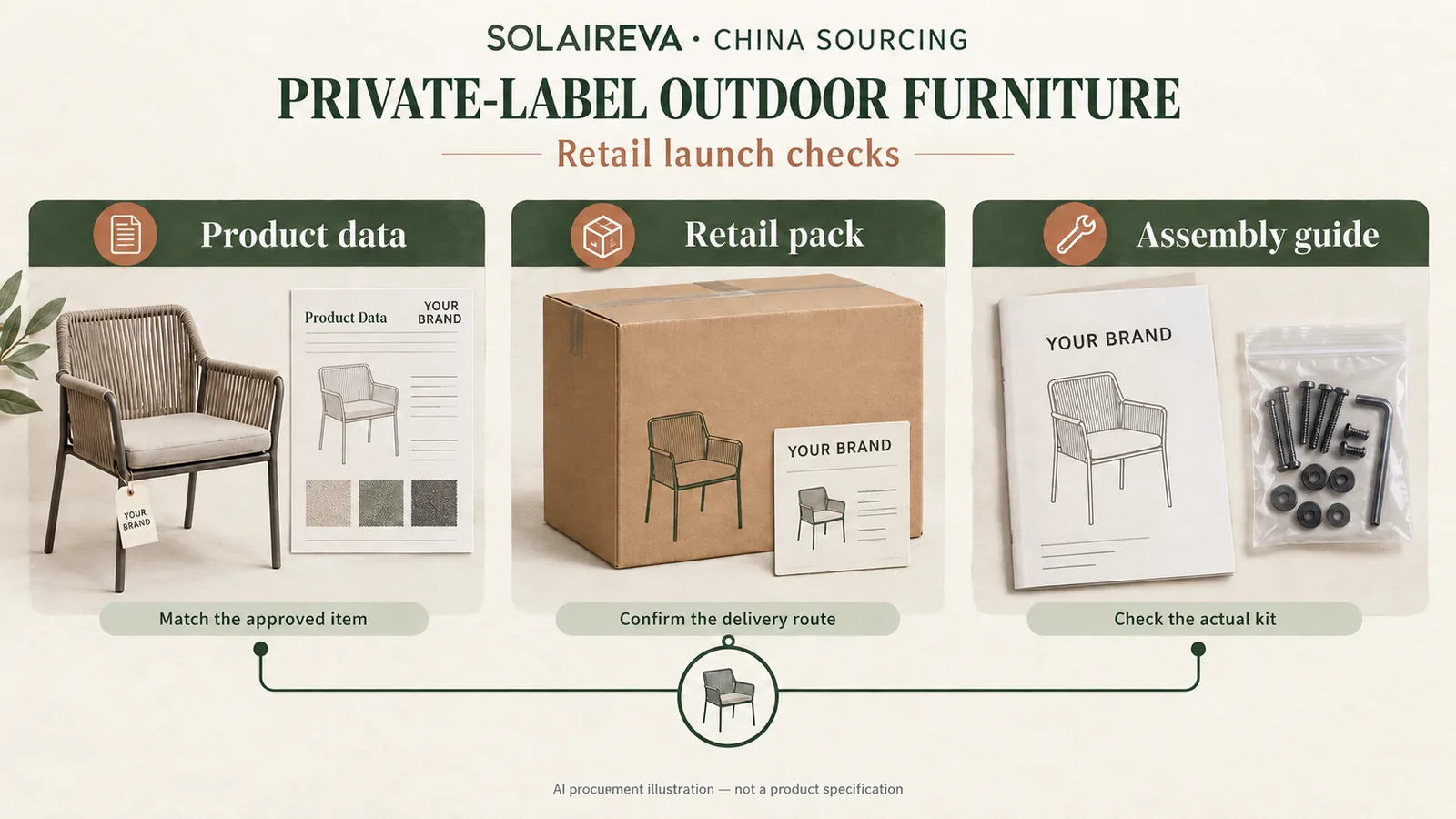
Define the retail launch deliverables before comparing factories
A private-label brand may sell a dining set in a store, ship a lounge chair from its own warehouse or supply a marketplace through a fulfilment partner. These channels need different operational information. State the destination, sales channel, receiving warehouse and final-delivery route in the first brief; “retail packaging” alone does not tell the factory how the item will be handled.
Separate the furniture decision from the launch-data decision. Selecting a standard frame with your finish and branding is different from developing a new design. The custom manufacturing guide explains development routes and cost boundaries; this page focuses on the handover needed to put the approved item into your retail system.
Start with the official outdoor furniture product range, mark the proposed variants and request a written deliverables list. Give each output an owner and an approval point: product data, photography, artwork, pack configuration, manual, care information and support references.
How to evaluate a private label outdoor furniture manufacturer in China
Ask the China supplier to demonstrate how one proposed item moves from sample to a controlled retail pack. Review connected records, not isolated examples of a logo, carton or showroom chair. Confirm which company manufactures the item and who controls outsourced printing, labels or packaging.
- Match the sample, drawing revision and material references to the quotation.
- Request a sample data sheet that distinguishes assembled and packed measurements.
- Review how factory model codes connect to your retail SKUs and variants.
- Ask how approved artwork, manuals and packing references reach production.
- Confirm who reports substitutions and who closes document or pack mismatches.
- Identify the support route for missing hardware and later component enquiries.
Use the factory and quality-control overview to structure the discussion, then request evidence for your proposed order. For wider supplier verification, use the China factory-audit checklist. A general factory photograph does not prove that a particular retail pack or manual has been approved.
Build a retailer-to-factory SKU map
Give each sellable configuration an unambiguous reference. A chair with one fabric is not automatically interchangeable with the same frame in another fabric. A set sold as one item can include several factory models and cartons. Record the relationship so that purchasing, receiving and customer service do not interpret a short product name differently.
| Record | What it identifies | Check before release |
|---|---|---|
| Retail SKU and variant | The item your customer orders | Finish, upholstery and included pieces match the listing |
| Factory model and revision | The approved construction and component references | Sample and released specification refer to that revision |
| Pack configuration | Cartons, contents and hardware for the sellable item | Receiving can identify a complete item or set |
| Manual and support references | Assembly, care and parts information | Documents match the kit the customer receives |
Provide your approved identifiers and label format. Verify that a scan in the intended warehouse system resolves to the correct item; do not treat a printed code as proof that the system mapping works. Where the channel distinguishes individual cartons, complete sets and spare components, document those relationships explicitly.
Approve product data from the actual variant
Request assembled dimensions and net weight separately from each carton's dimensions and gross weight. Define the measurement orientation and units. For modular seating, distinguish a single module from the complete configuration. For a furniture set, list the supplied pieces and any cushions, covers or accessories that are not included.
Connect each photograph to the approved model, finish and fabric. Confirm permission to use the files and whether the image is a photograph, render or conceptual scene. Ask for an uncluttered view, useful detail views and a dimension drawing where available. A lifestyle picture should not accidentally imply that an umbrella, table or decorative accessory is supplied.
As a public example, IKEA's US VITTSKÄR outdoor-set page separates measurements, component information and assembly/care documents. Checked on 11 October 2026, this illustrates useful retail information organisation—not a SOLAIREVA specification, endorsement or permission to reuse IKEA files.
Keep performance and material claims tied to relevant evidence for the exact configuration. Do not turn a coating name, attractive image or another model's test into a claim for every item in your collection. Your listing reviewer should reconcile the final copy with the released specification before the item goes live.
Check the assembly guide against the supplied kit
Conduct a documented assembly review using the proposed retail pack, supplied hardware and intended tools. The reviewer should be able to identify parts and follow the instructions without relying on undocumented workshop knowledge. Check the orientation of similar-looking components, the sequence of operations and access to the relevant joints.
Record missing parts, mismatched illustrations and unclear steps, then review the corrected manual with the corrected kit. Ask the factory to confirm model-specific fastening instructions rather than inventing a universal torque, tightening sequence or safe-load figure. If a model is delivered assembled, confirm what the customer still needs to install or check.
Agree the language, part references, revision and support contact for each destination. Care directions should describe the actual materials and removable covers. The outdoor cushion specification guide provides material-level questions; its hotel context is not a substitute for your retail product's care sheet. The illustration above is a procurement reminder, never an assembly instruction.
Match the retail pack to the distribution route
Map the full journey: export loading, destination unloading, storage, picking, possible repacking and final delivery. Record where a unitised load is split into individual items and where furniture cartons receive additional handling. Confirm whether a sellable set travels together or as separate packages and how the recipient identifies completeness.
ISTA's global packaging design and testing guidance links test selection to the actual distribution environment and the decision the test is intended to support. Checked on 11 October 2026, this supports discussing the route with a packaging specialist; it does not prescribe one protocol for all furniture or certify a SOLAIREVA pack.
Request a record of the actual product-pack configuration and any applicable test scope, results and changes since testing. Identify protection at vulnerable finishes and joints, hardware containment, carton contents and the opening sequence. A photograph of container loading does not establish suitability for a different home-delivery route.
Ask your retailer, fulfilment provider or packaging specialist to confirm the assessment required for the actual channel. Do not assume that a test report for another size or protection system covers your order. The container-loading guide addresses the export leg; retail delivery needs its own route review.
Approve labels and brand artwork in context
Show where each brand element goes: hang tag, cushion label, frame mark, carton, booklet or digital file. Review a physical proof for readability, placement and whether it interferes with a removable cover, joint or care information. Separate a cosmetic branding change from a change to the furniture construction.
Allocate the review of destination-specific labels, warnings and claims to the appropriate qualified reviewer. Branding is not a reason to omit information required for the actual product and market. This guide does not determine legal labelling obligations or promise marketplace approval; the factory should receive the buyer's approved requirements and flag unclear inputs.
Ask SOLAIREVA to quote the proposed branding and documentation work separately from furniture production. Confirm the actual options, approvals and exclusions through the private-label and OEM/ODM discussion page, not an assumed universal service package.
Release one coordinated revision before launch
Assemble a release folder containing the approved product specification, SKU map, material references, artwork, pack record, manuals and permitted digital assets. Give each document a revision and approval status. Make sure production uses the released version while retail staff use the matching data, images and included-items list.
Review one representative retail pack from opening to complete assembly. Reconcile its contents with the listing, manual and component records. A general sample approval may leave print artwork or the final hardware bag unresolved; list those open items and close them before the relevant work is released.
If a finish, fitting, cushion or packing method changes, identify which customer-facing files and support references also need review. Retain a change history rather than silently replacing a photo or PDF. Use the sample sign-off guide for approval-record discipline, and the supplier issue-record guide for connecting later enquiries to the original order.
Send a retail-ready RFQ to the China manufacturer
Send every shortlisted private-label outdoor furniture supplier in China the same launch brief. Include these inputs so that a furniture-only quotation is not compared with a proposal that also covers photography, printed cartons and manual preparation:
- Destination market, retail channel, receiving warehouse and final-delivery route.
- Product references, quantities, variants and the sellable-item or set definition.
- Retail SKU mapping and approved item/carton identifiers.
- Required product measurements, photographs, drawings and usage permissions.
- Brand artwork, placement, proofs and destination-review responsibilities.
- Pack contents, assembly/care languages, hardware and support references.
- Packaging assessment scope and model-specific evidence requested.
- Approval owners, document revisions, launch milestones and change controls.
- Separate furniture, label, carton and document minimums and setup charges.
Ask for current terms by model and variant. The MOQ guide explains why print batches and material batches can have different minimums, while the wholesale sourcing guide covers broader range and repeat-order planning. No universal MOQ, launch deadline, price or damage-rate reduction is promised here.
Questions retail buyers ask a China private-label factory
What should I ask a private label outdoor furniture manufacturer in China before launch?
Request a matched approval package: the exact furniture variant, retailer-to-factory SKU map, measured product and pack data, brand artwork, assembly and care documents, packaging evidence and sample decisions. Agree who approves each file and how later changes reach production, listings and customer support.
Does private-label patio furniture require a new OEM design?
Not necessarily. Private label describes the customer-facing brand; it can use a selected catalogue model or a newly developed design. Confirm the actual changes, available options, design permissions and deliverables with the China supplier. A branded carton does not itself mean a new frame has been engineered.
Can I use the factory's catalogue photos for my online furniture listing?
Confirm permission and whether each image shows the exact approved variant, finish, cushion and included pieces. Use measured specifications and an explicit included-items list. Label renders or conceptual scenes clearly; a photograph alone does not verify dimensions, performance or the contents of the retail pack.
Is export packaging enough for online patio furniture delivery?
Do not assume so. Map the route from the China factory through unloading, storage, picking and final delivery. Ask a packaging specialist to assess the actual product-pack combination and relevant test scope. Container packing or an unrelated test report does not establish suitability for a different home-delivery route.
How should I approve outdoor furniture assembly instructions?
Review the manual using the actual approved kit, hardware and tools. Check part identification, orientation, sequence, missing-parts reporting, model reference and language. Record any mismatch and confirm the corrected version before bulk release. The illustration in this guide is not an assembly manual.
What determines the MOQ for a private-label outdoor furniture order from China?
Ask for separate minimums and setup costs for the furniture model, finish or fabric, labels, printed cartons and documents. Confirm whether each applies to a variant, an order or a repeat print run. There is no universal MOQ or launch lead time in this guide; request current terms for your actual range.
Scope: Manufacturer-authored procurement guidance, checked on 11 October 2026. Third-party resources illustrate information organisation and packaging assessment, not SOLAIREVA product evidence. Confirm the actual order and destination requirements; this page is not a legal assessment, test report or marketplace approval.
Discuss your own-brand outdoor furniture launch
Send SOLAIREVA your proposed range, sales channel, destination and launch deliverables. Request a model-specific furniture, packaging and documentation proposal.
Send the retail launch brief to the official team →